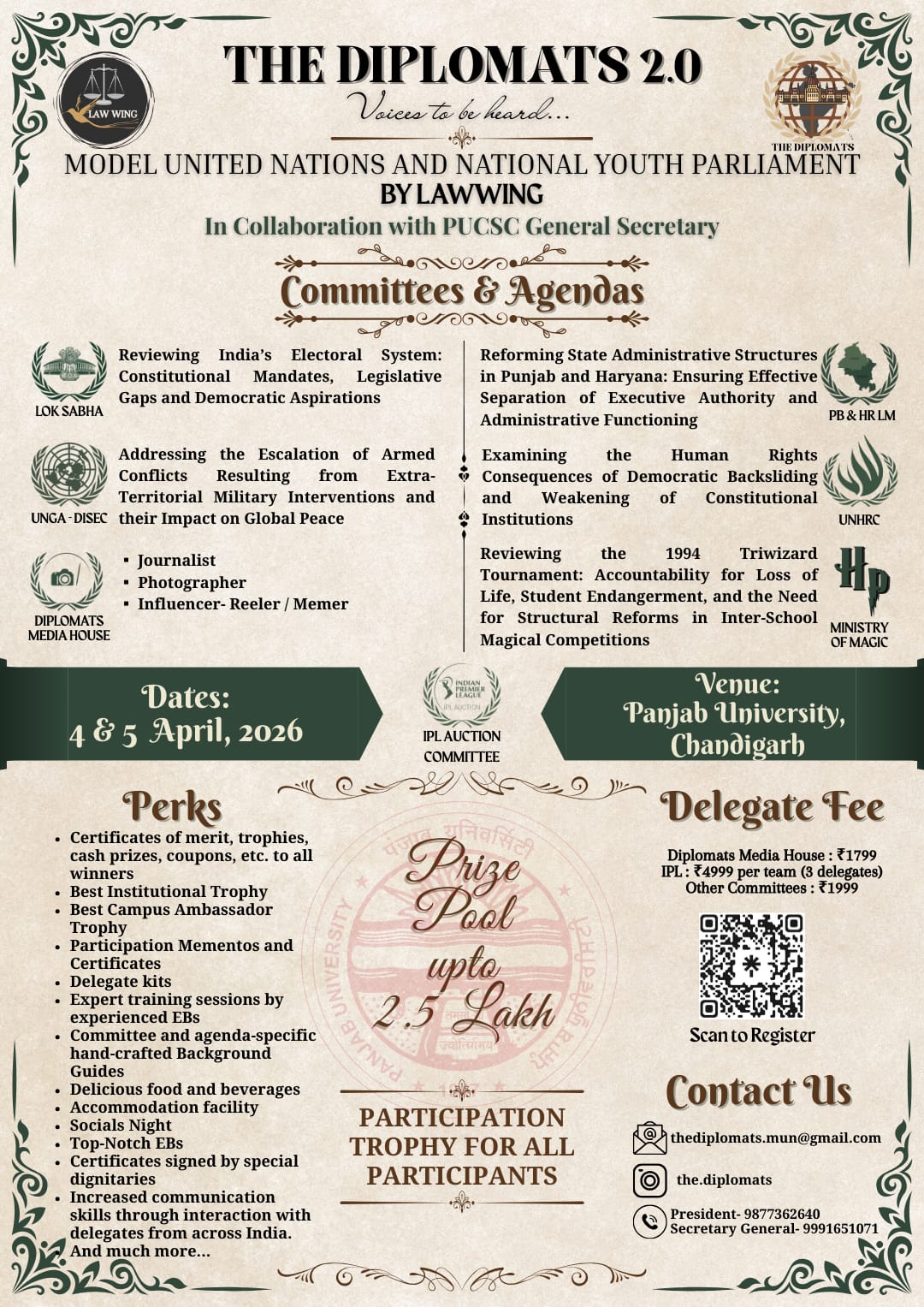
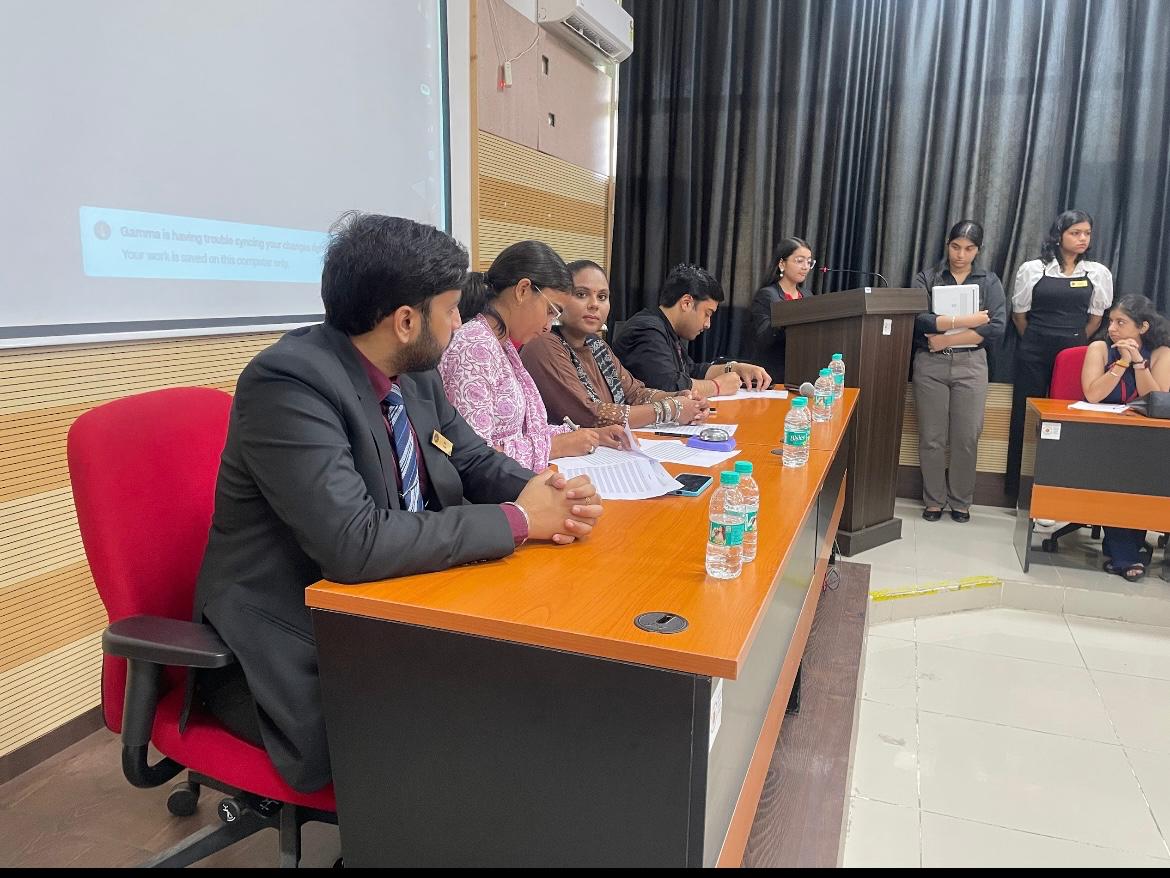
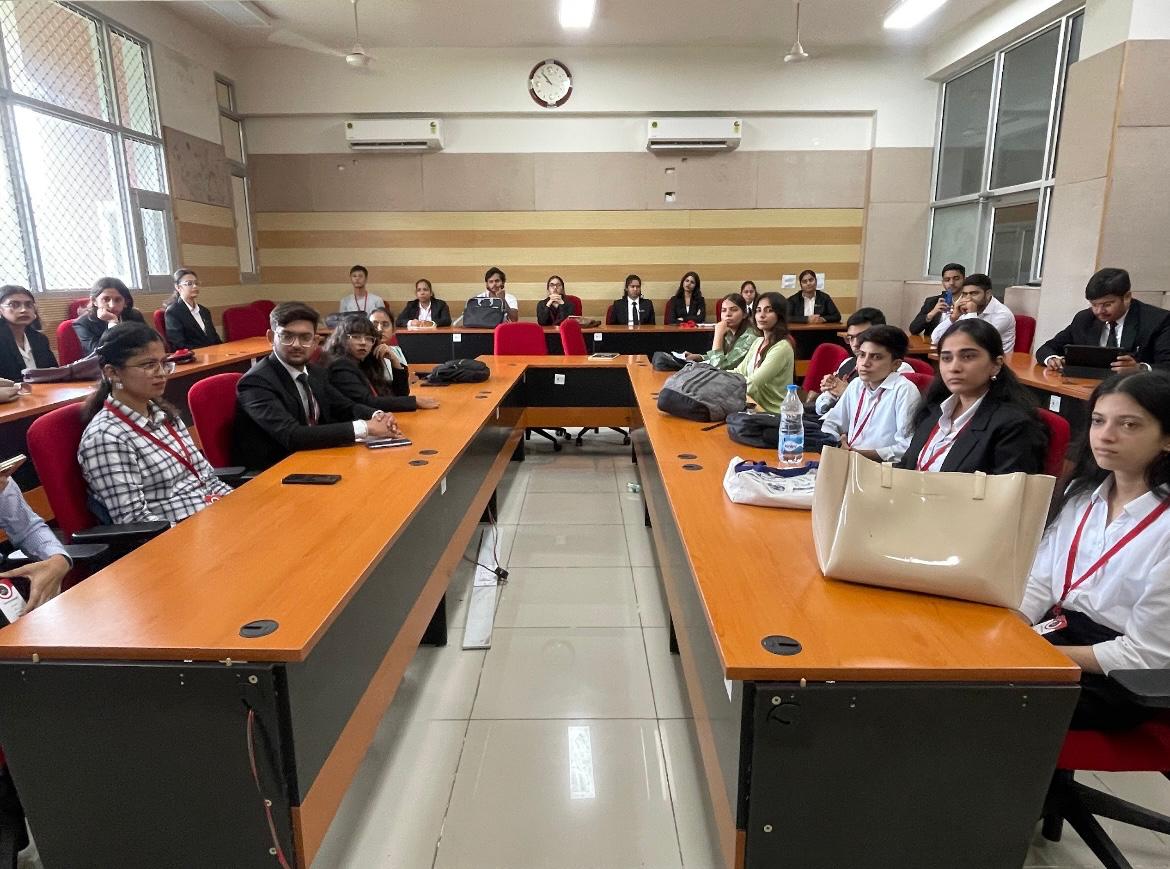
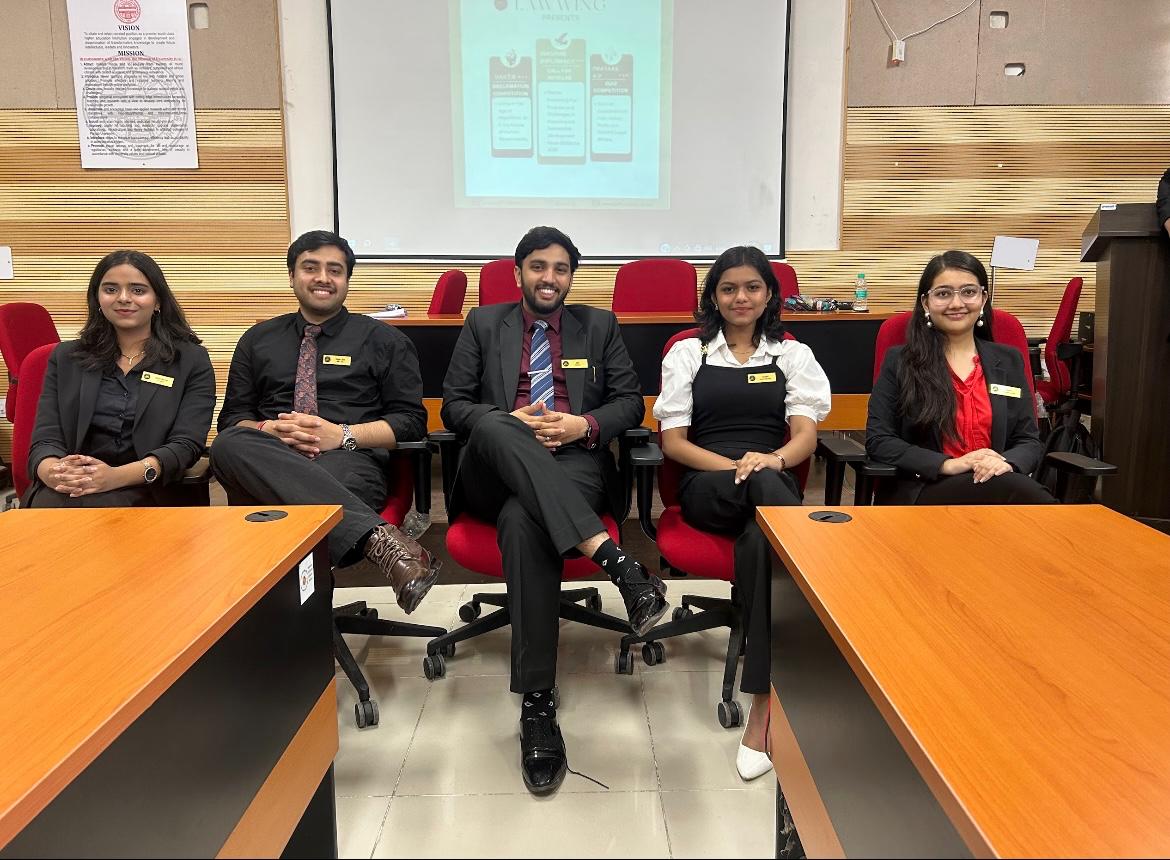
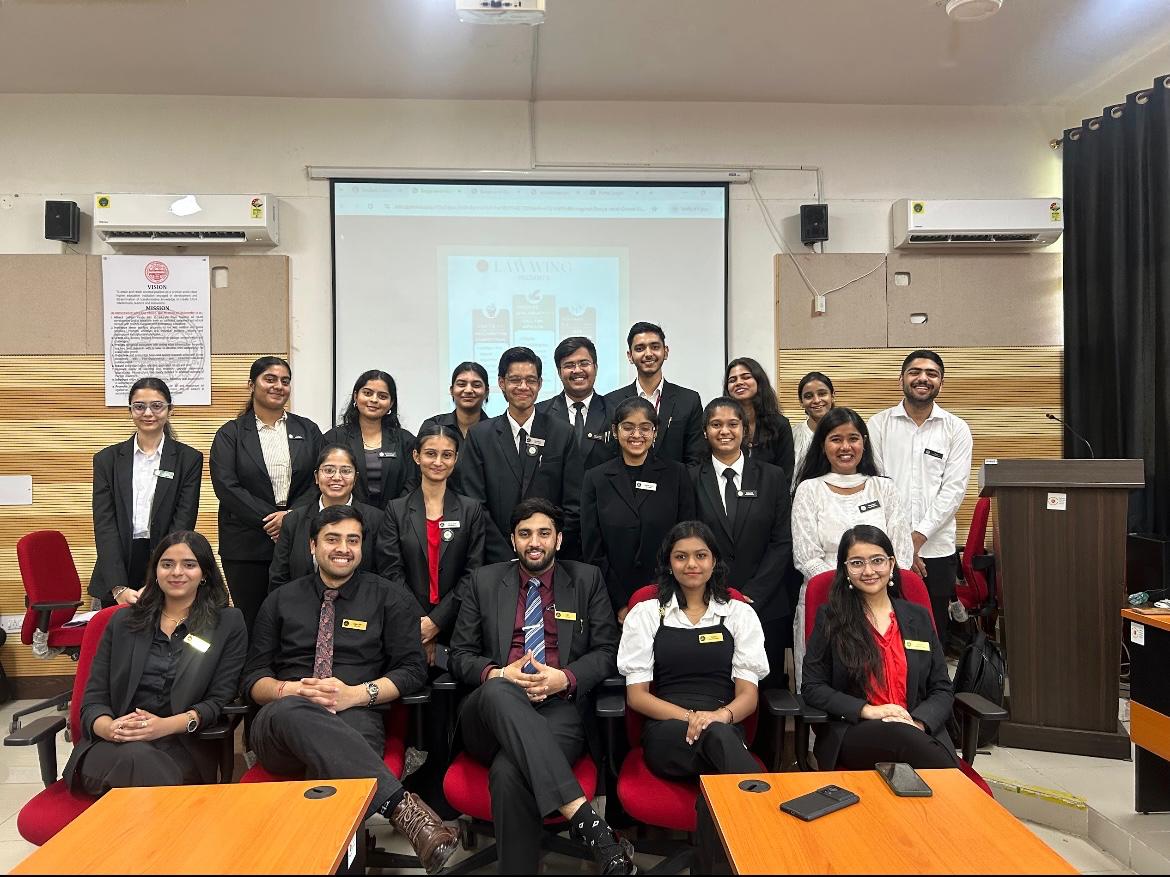
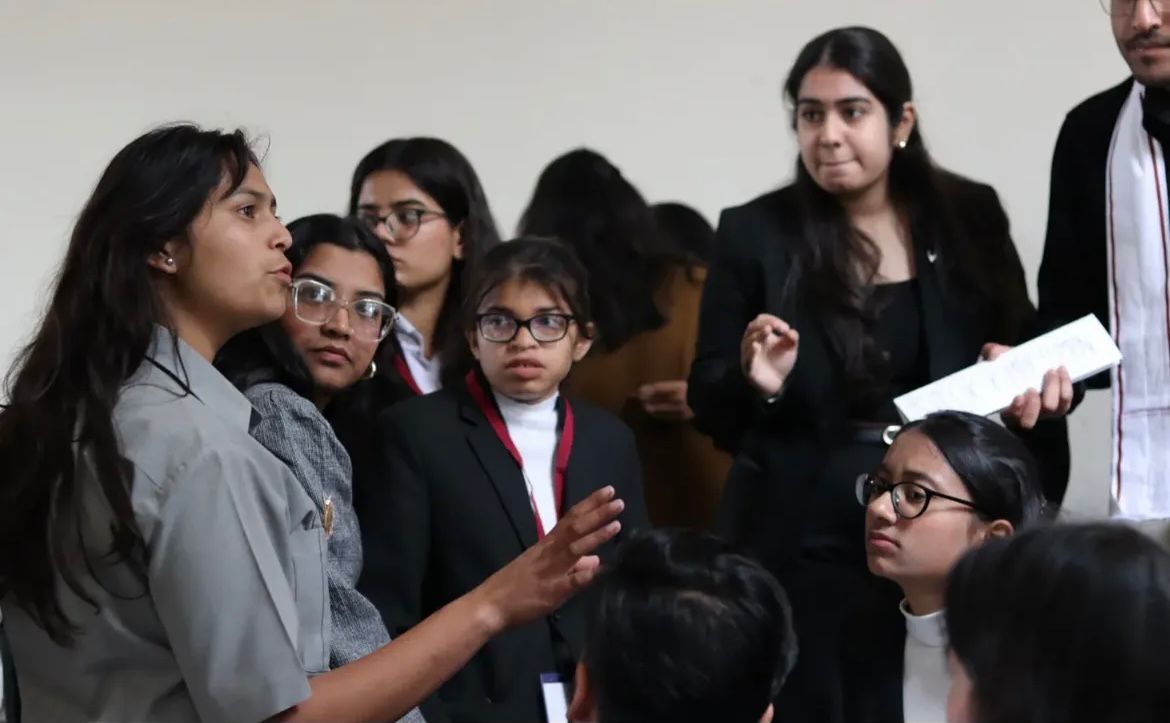
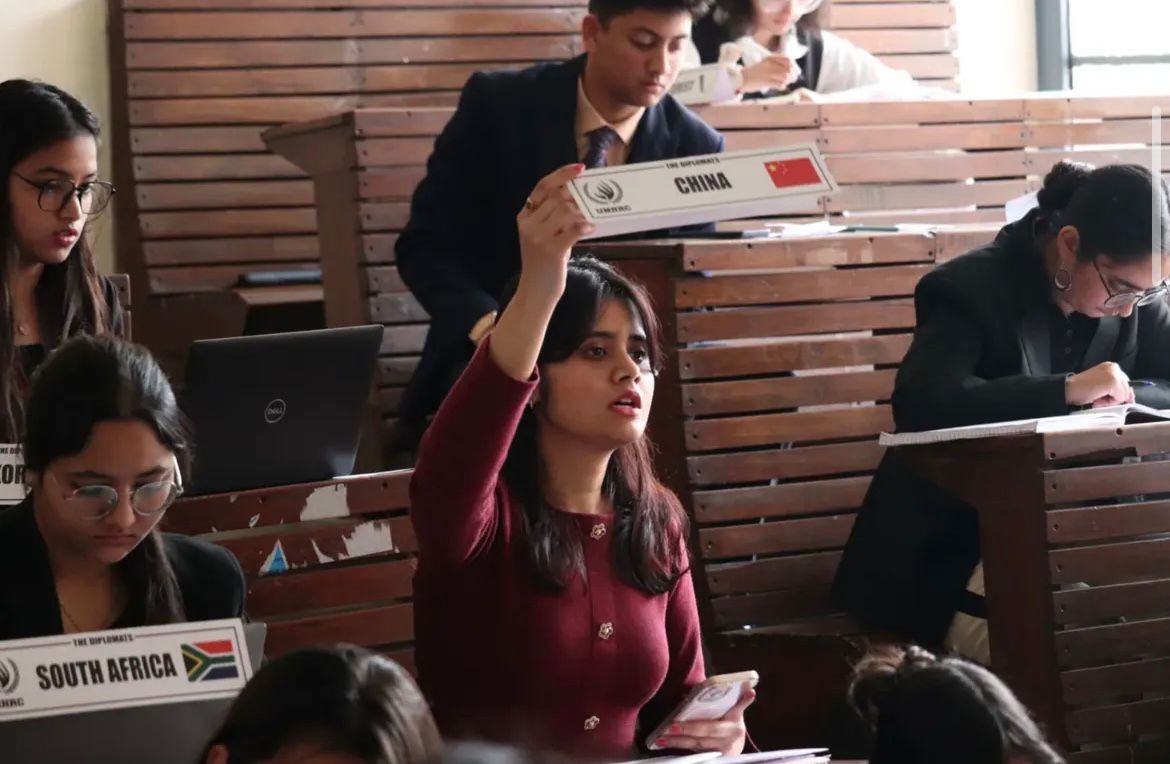
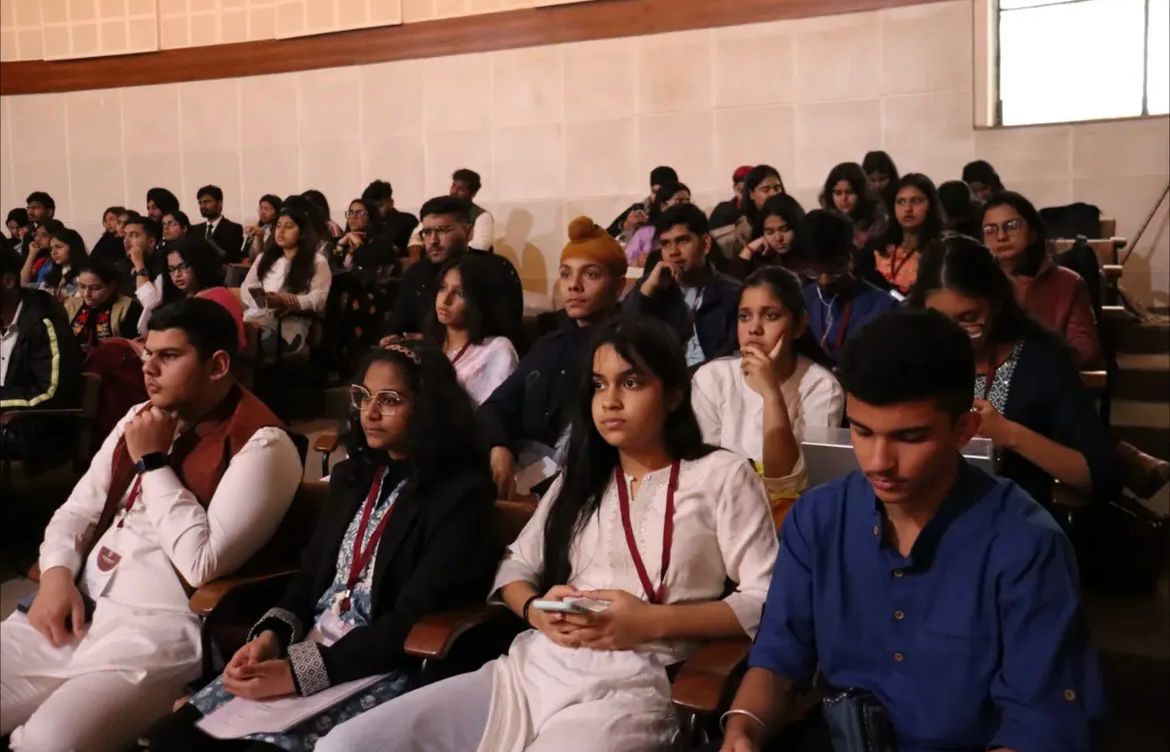
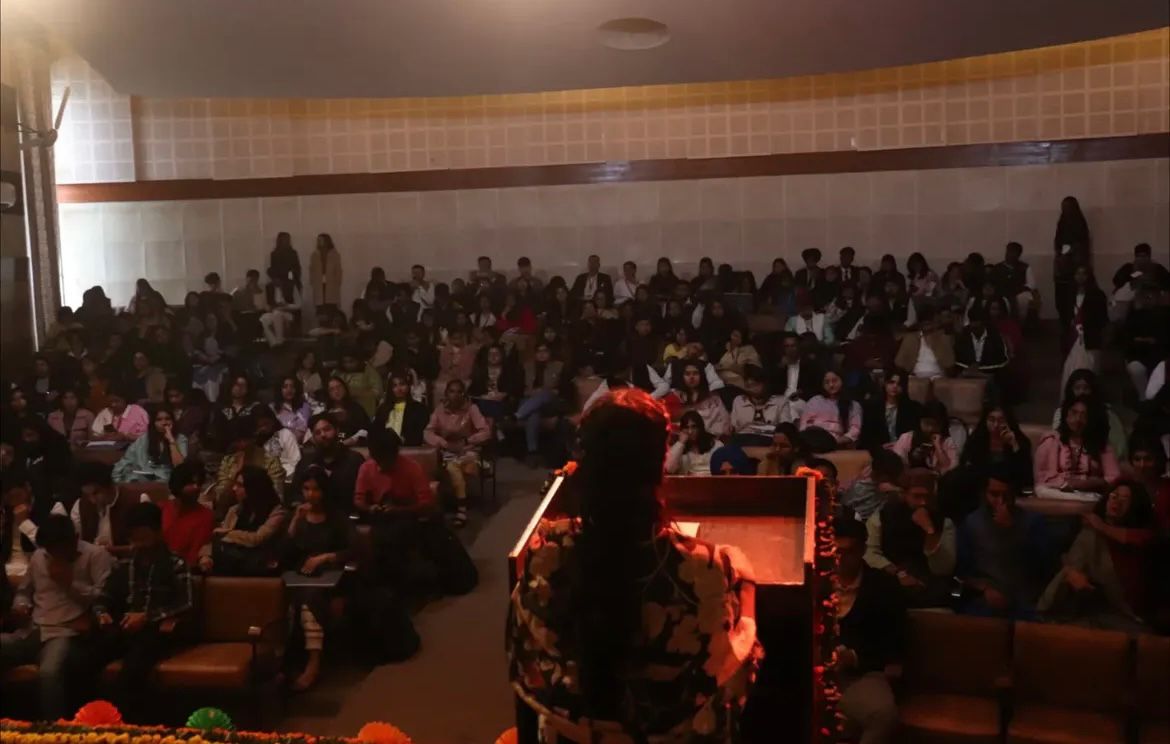
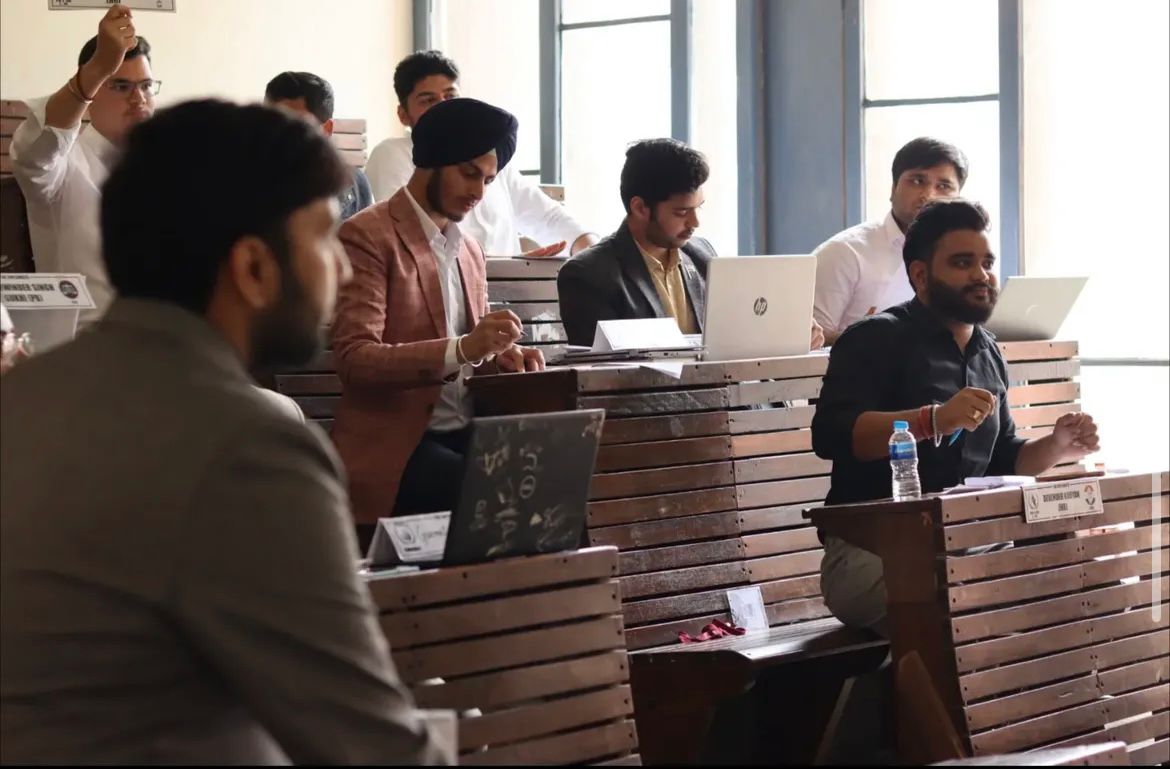
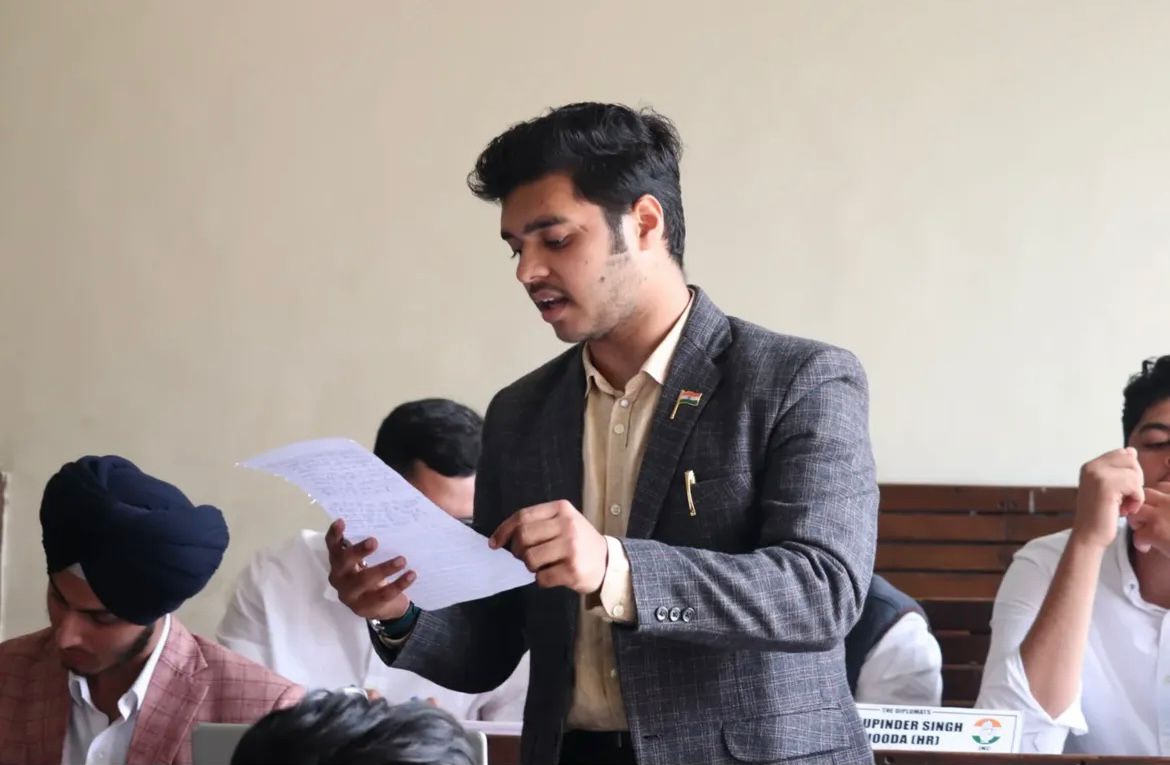
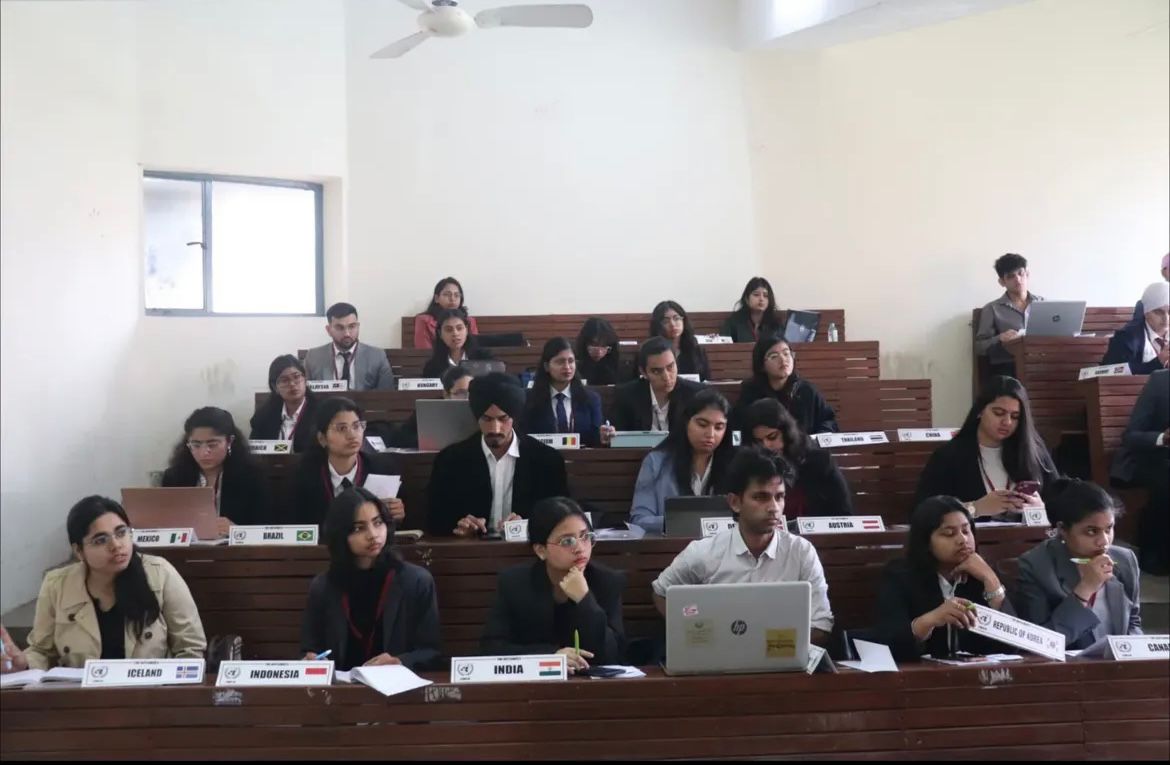
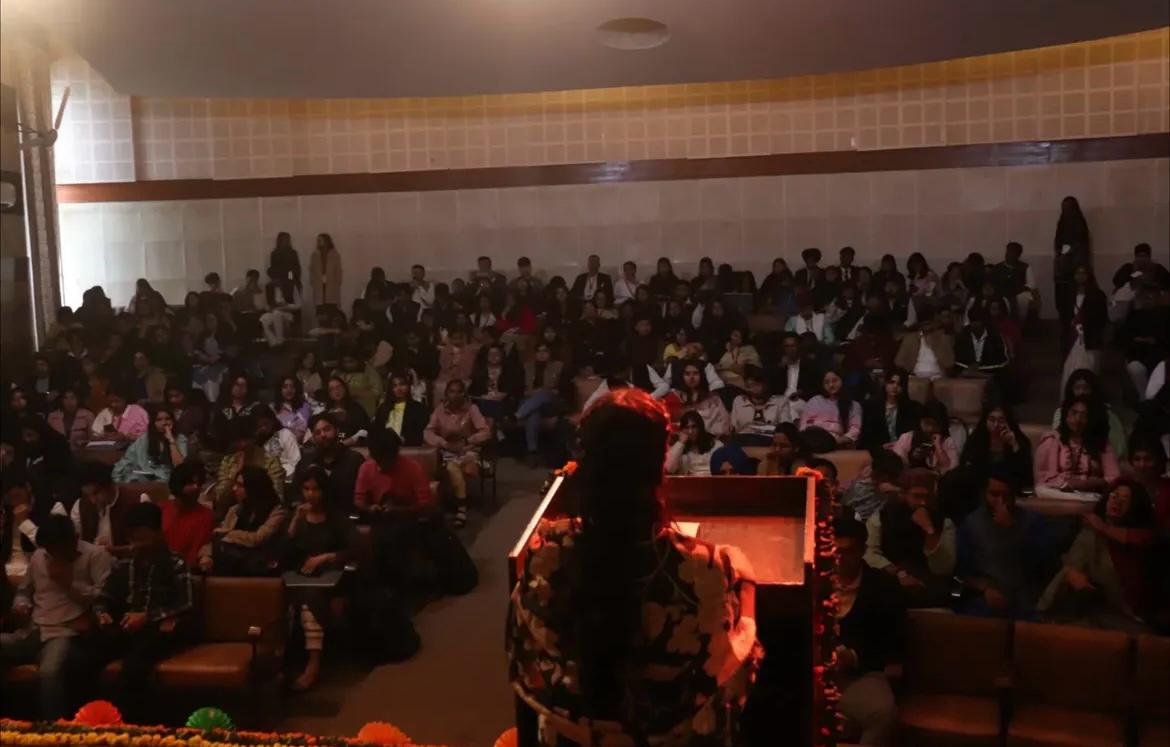
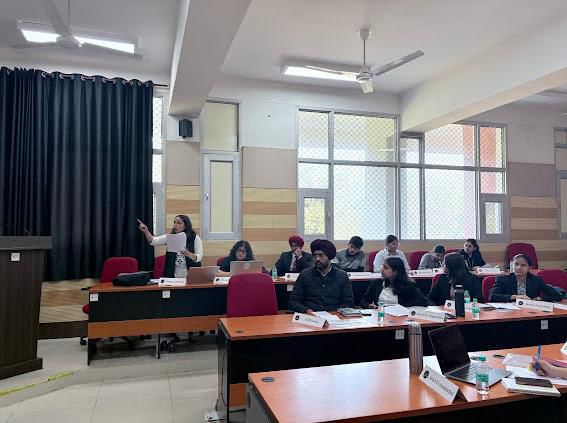
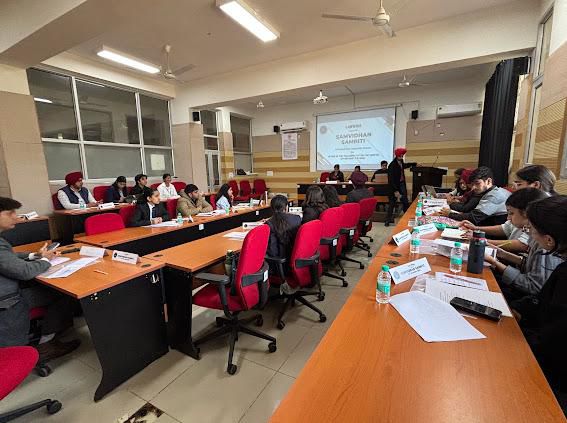
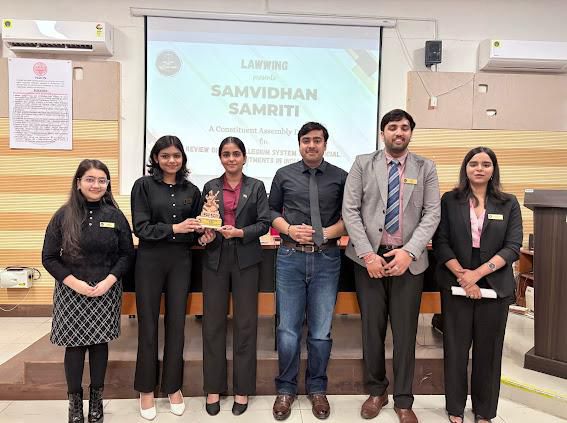
Law Wing is a registered student-led initiative committed to fostering legal consciousness,
political literacy and participative leadership among youth through platforms like Quiz,
Debates, Model United Nations (MUN) and Youth Parliament (YP).
We strive to provide students with immersive experiences that promote a deeper understanding of
national and international governance frameworks, legal systems, and socio-political issues.
25+
UNIVERSITIES
1000+
PARTICIPANTS
10+
MAJOR EVENTS
5+
YEARS LEGACY
OUR OBJECTIVES
Legal Discourse & Democratic Dialogue
Facilitating legal discourse and democratic dialogue to create an inclusive space for
participants to engage in contemporary legal and political debates and to nurture analytical
thinking and effective communication through structured committee formats.
Spreading Legal Awareness
Spreading legal awareness and understanding to introduce students to the functioning of Indian
legislative bodies and international institutions. To focus on pertinent issues such as human
rights, constitutional law, public policy and global governance.
Building Future Leaders
Building a community of future leaders to bring together law students, political science
enthusiasts, aspiring bureaucrats, and youth leaders for intellectual collaboration. To
encourage leadership and teamwork through inter-collegiate and inter-school conferences.
Capacity Building Resources
Providing capacity-building resources to organize training workshops that equip participants with
procedural knowledge of MUNs and YPs. To offer curated study materials, mentorship, and guided
content to ensure effective participation and learning.
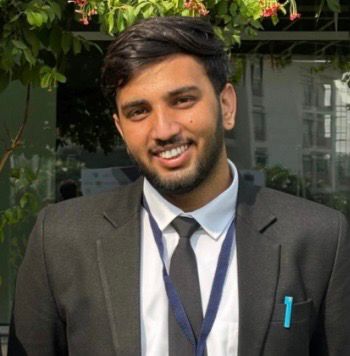
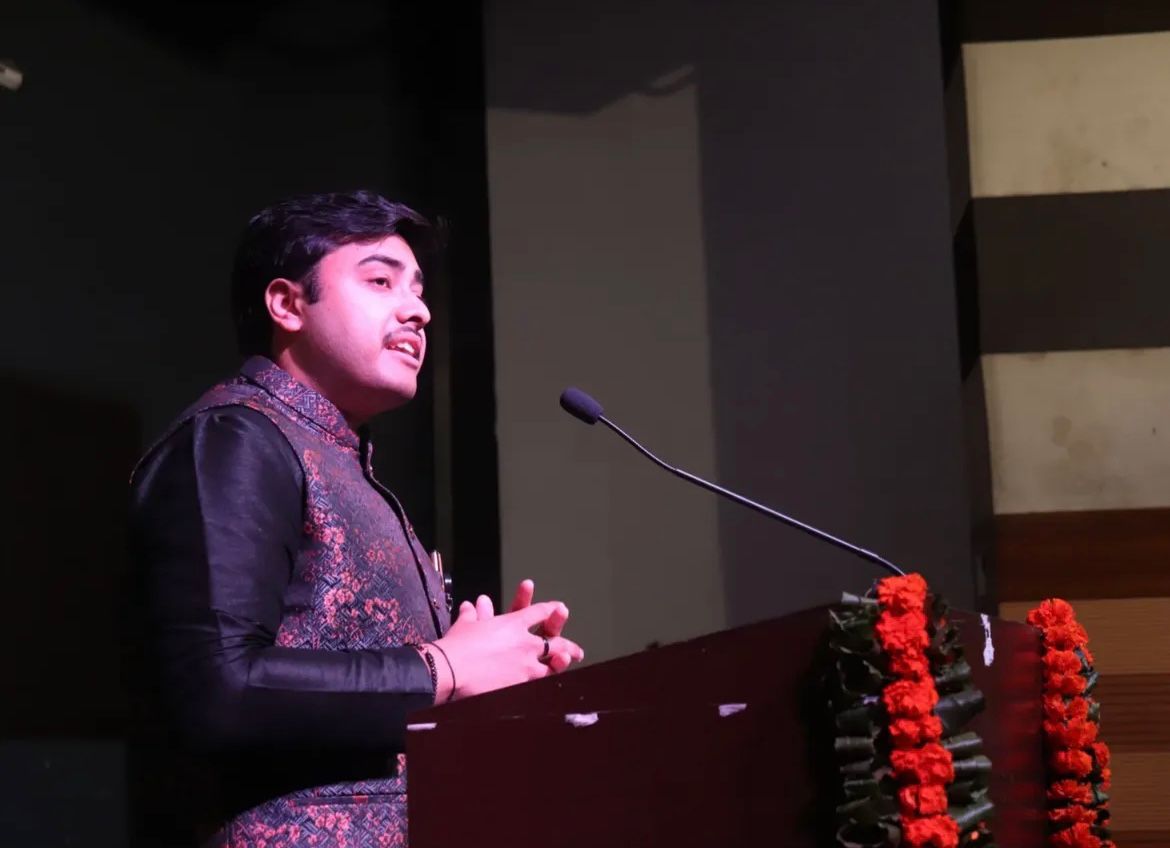
MR. DEV
Founder & CEO
MESSAGE FROM OUR FOUNDER
At Law Wing, we began with a simple idea — to create a space where young minds could engage with
the law not just as a subject, but as a powerful tool for change. This journey has been built on
passion, purpose, and the belief that students can lead with impact when given the right
platform.
Every event we've hosted, every post we've shared and every step we've taken reflects our
commitment to learning, leadership and legal empowerment. Law Wing is more than an organization
- it's a movement driven by voices like yours.
And this is just the beginning. Let's continue to grow, inspire, and lead - together.
OUR BOARD OF DIRECTORS
The Minds Behind The Movement
MR. DEV
Founder & CEO
MR. SAGAR JAIN
Managing Director & Chief Legal Officer
MS. ANJALI NAVRAJ
President
MS. SHUCHI
Executive Director
MS. TARUSHI
General Secretary
MEET THE HOD'S
The Minds Behind The Movement
MS. NANCY SAINI
HOD Management
MS. GARISHA
HOD PR
MS. NABIHA ANSARI
HOD Content Team
PUBLICATIONS
Legal Insights & Research
📚
Coming Soon - Stay Tuned!
LEGAL NEWS
Latest Updates & Developments
Madras High Court03 October 2025
Madras High Court Constitutes SIT for Swift Probe into Karur Stampede
The Madras High Court ordered the formation of a Special Investigation Team to probe the
Karur
stampede that claimed 41 lives during a political rally led by actor-turned-politician
Vijay.
Karur Tragedy: On October 3, 2025, the Madras High Court constituted a
Special Investigation Team (SIT) to investigate the tragic stampede that occurred in
Karur
on September 27, resulting in the loss of 41 lives.
The stampede took place during a rally organized by actor-turned-politician Vijay.
Justice Senthilkumar strongly criticized the leadership of the Tamilaga Vettri Kazhagam
(TVK),
observing that the organizers had “abandoned” the crowd.
Emphasizing accountability, the Court remarked,
The SIT will be headed by Inspector General Asra Garg,
with Superintendents of Police Vimala and Shyamaladevi
as members.
The team has already commenced investigation and conducted a site visit.
The probe will examine allegations of overcrowding, security lapses,
and delayed emergency response.
The Madras High Court has directed the SIT to submit its report by
October 14, 2025.
Financial & Digital Reforms01 October 2025
India Rolls Out Major Financial and Digital Reforms from October 1
India implemented sweeping financial and digital reforms from October 1, 2025, aimed at
strengthening transparency, enhancing security in transactions, and tightening regulatory
oversight
across banking, payments, and public services.
From October 1, 2025, India introduced a series of major financial and
digital
reforms designed to make transactions safer, reduce fraud, and reinforce accountability
across
banking and digital payment systems.
Key changes include allowing full-equity investments under the National Pension
System
(NPS),
faster cheque clearance mechanisms, a nationwide ban on online betting
platforms,
and the suspension of the UPI “Collect” feature to curb misuse.
Additional measures include revised bank charges, increased
Speed Post
fees,
mandatory Aadhaar authentication for secure digital transactions,
restrictions on early IRCTC ticket bookings,
limitations on Non-Resident Indian (NRI) Public Provident Fund (PPF)
accounts,
and the introduction of new Goods and Services Tax (GST) compliance
norms.
These reforms aim to strengthen financial discipline, improve consumer protection,
and enhance regulatory oversight across public and private financial ecosystems.
Experts have noted that while certain measures may increase compliance burdens in the
short term,
the reforms are expected to significantly boost transparency, curb fraudulent practices,
and build long-term trust in India’s financial and digital infrastructure.
the government emphasized, underscoring the
objective of reinforcing confidence in digital payments and public financial systems.
Sports & Public Discourse28 September 2025
India Clinches Asia Cup Title in a Pulsating Final Against Pakistan
India defeated Pakistan by six wickets in a thrilling Asia Cup final at Dubai on September
28, 2025,
securing their eighth Asia Cup title and extending their dominant unbeaten run in ICC
encounters.
India clinched the Asia Cup 2025 title with a commanding six-wicket
victory over
Pakistan in a high-voltage final held at Dubai on September 28, 2025.
Chasing Pakistan’s target, the Indian team displayed remarkable composure under pressure,
with key players delivering crucial performances to steer the side to victory.
The win marked India’s eighth Asia Cup title and extended their unbeaten
streak
against Pakistan in ICC tournaments to 13 consecutive matches,
reinforcing India’s dominance in high-stakes encounters.
Celebrating the collective effort, the Indian camp emphasized unity and teamwork,
echoing the sentiment that
However, the final also sparked a post-match controversy when
Pakistan Cricket Board (PCB) Chairman Mohsin Naqvi
was seen holding the Asia Cup trophy during the presentation ceremony.
The incident drew criticism from former Indian cricketer Harbhajan
Singh,
who termed the act inappropriate, triggering widespread debate among fans, analysts,
and former players.
Social media platforms across both nations witnessed intense discussions,
reflecting the enduring rivalry and the broader public discourse surrounding the match
and its aftermath.
Election Commission of India2025
ECI Unveils 17 New Initiatives for Bihar Assembly Polls
The Election Commission of India has announced 17 new measures aimed at ensuring free, fair,
and efficient elections for the Bihar Assembly polls scheduled in 2025.
In preparation for the Bihar Assembly Elections 2025,
the Election Commission of India (ECI) has proposed
17 new initiatives to strengthen electoral integrity
and enhance voter convenience.
Chief Election Commissioner Gyanesh Kumar stated that the reforms
are aimed at reducing long queues, minimizing overcrowding,
and ensuring a smoother voting experience across the state.
As part of the new framework, each polling station will now cater to
a maximum of 1,200 voters,
enabling faster and more organized polling procedures.
The ECI has also placed significant emphasis on
accessibility for differently-abled voters,
along with expanded facilities for
women and senior citizens.
Further measures include enhanced security protocols
and upgraded infrastructure at polling stations to ensure
safety, transparency, and orderly conduct during polling.
Observers have noted that these initiatives are expected to make the
2025 Bihar elections smoother, safer, and more efficient,
reinforcing public trust in the electoral process.
Supreme Court of India06 October 2025
Supreme Court Directs High Courts to Stay Within Pleadings and Jurisdiction
The Supreme Court set aside a Kerala High Court order against the Chinmaya Mission
Educational &
Cultural Trust, holding that the High Court exceeded its jurisdiction and violated
principles of
natural justice.
On October 6, 2025, the Supreme Court of India
quashed an order of the Kerala High Court that had directed
the Cochin Devaswom Board to revise licence fees and initiate
an inquiry against the Chinmaya Mission Educational & Cultural Trust.
The apex court observed that the High Court had
travelled beyond the scope of the pleadings
and acted outside its jurisdiction.
The Supreme Court further noted that the Trust was
not afforded a fair opportunity of being heard,
thereby violating the fundamental principles of
natural justice.
Emphasizing judicial restraint, the Court reiterated that
High Courts must confine themselves to the issues raised
before them and avoid issuing directions beyond the
framework of the dispute.
The ruling reinforced the principle that
underscoring the necessity of procedural fairness in
administrative and judicial decision-making.
Taxation & Constitutional Law04 October 2025
Supreme Court to Hear Challenge Against Securities Transaction Tax
The Supreme Court has agreed to hear a petition challenging the Securities Transaction Tax,
with petitioners alleging that the levy amounts to double taxation and burdens investors.
On October 4, 2025, the Supreme Court of India
agreed to examine a petition challenging the
Securities Transaction Tax (STT) imposed on stock market trades.
The Court issued a notice to the Central Government,
seeking its response to the plea which contends that
the STT amounts to double taxation.
The petitioners argued that the tax is levied on
both the buying and selling of securities,
thereby violating principles of tax fairness and
imposing an undue financial burden on investors.
It was further contended that the STT discourages
market participation, adversely impacts liquidity,
and undermines investor confidence.
The Supreme Court has scheduled hearings to assess
whether the existing STT framework aligns with
constitutional and fiscal principles,
particularly in relation to potential instances of
impermissible double taxation.
Enforcement DirectorateOctober 2025
ED Warns Against Fake Summons, Launches QR Code Verification System
The Enforcement Directorate has introduced a QR-code based verification system on its
summons
to prevent fake notices, digital arrest scams, and misuse of its name.
The Enforcement Directorate (ED) has rolled out a
QR-code based verification system on all its summons
to curb the rising incidents of fake notices and digital arrest scams.
Individuals receiving summons can now scan the QR code to instantly verify
whether the notice is genuine through the ED’s official website.
This move follows multiple reports of fraudsters impersonating ED officials
to extort money or create panic among citizens.
The agency stated that the system will be integrated into
all official communications and summons,
ensuring transparency and easy public verification.
Describing the initiative as
authorities emphasized that the reform will strengthen
public trust, accountability, and cybersecurity
in law enforcement processes.
The initiative reflects the ED’s broader effort to modernize its operations
and prevent misuse of its institutional identity in digital spaces.
Supreme Court of India2025
SC: Age Bar Under Surrogacy Act Will Not Apply to Pre-2021 Cases
The Supreme Court ruled that couples who began the surrogacy process before
the 2021 Act came into force will not be affected by its age restrictions.
The Supreme Court of India has held that the age restrictions
introduced under the Surrogacy (Regulation) Act, 2021
will not apply to couples who had initiated the surrogacy process
before the law came into effect.
The Court noted that such couples had already taken
substantial steps, including freezing embryos,
thereby acquiring a vested right
to continue the process.
The ruling protects the reproductive rights and autonomy
of couples and prevents the law from being applied retrospectively.
Emphasizing the principle of non-retroactivity, the bench observed that
laws cannot take away rights that were
lawfully exercised before their enactment.
The Court further underlined that
reproductive choices form part of the fundamental right
to personal liberty and privacy under Article 21 of the Constitution.
Legal experts have welcomed the judgment as a
progressive and humane interpretation,
shielding couples from undue hardship caused by procedural changes.
Military & Constitutional Law2025
Supreme Court: AFT Can Modify Court-Martial Convictions
The Supreme Court ruled that the Armed Forces Tribunal has the authority
to modify court-martial convictions and reduce penalties,
reinforcing fairness in the military justice system.
The Supreme Court of India has ruled that the
Armed Forces Tribunal (AFT) possesses the authority
to modify convictions and reduce punishments imposed
through court-martial proceedings.
The Court clarified that the AFT’s jurisdiction extends beyond
merely examining the legality of a sentence and includes
reviewing its proportionality.
Emphasizing constitutional balance, the bench observed that
discipline in the armed forces must be maintained
without compromising on justice.
Stating that
the Court held that military justice must align with
fairness, due process, and constitutional principles.
The judgment clarified that the AFT’s role is
judicial and not merely administrative,
empowering it to correct excessive or unjust punishments.
Legal experts have hailed the verdict as a
progressive balance between institutional discipline
and individual rights within military law.
Supreme Court of India08–14 October 2025
Supreme Court Orders CBI Probe into Karur Stampede
The Supreme Court has ordered a CBI investigation into the Karur stampede,
appointing a retired Supreme Court judge to monitor the probe to ensure
transparency and impartiality.
The Supreme Court of India has directed a
Central Bureau of Investigation (CBI) probe into
the tragic Karur stampede, which claimed several lives.
To ensure transparency and impartiality, the Court appointed a
retired Supreme Court judge to monitor the investigation.
The decision was taken after serious concerns were raised regarding
local administrative negligence and lapses in
crowd management.
The apex court emphasized the need for a
thorough and independent inquiry to identify failures
in crowd control and emergency response mechanisms.
The Court also directed that
regular progress reports be submitted to the
monitoring judge to ensure accountability throughout the probe.
Legal experts have noted that the order sets a strong precedent for
strict accountability in public safety matters,
particularly for large public gatherings across the country.
Delhi High Court2025
Delhi High Court Orders CDR Check in NDPS Case to Protect Privacy
The Delhi High Court directed retrieval of call data records of a police
raiding team in an NDPS case to verify lawful use of informers and prevent
misuse of power.
The Delhi High Court has ordered the retrieval of
call data records (CDRs) of a police raiding team
involved in an NDPS case.
The direction was issued to examine whether informers were used
lawfully and to determine if any
misuse of power occurred during the operation.
The Court stressed that transparency and
respect for privacy must be maintained even during
narcotics investigations.
Observing that
the bench emphasized that law enforcement agencies must operate
strictly within legal boundaries.
The Court directed that the CDRs be examined under
strict confidentiality, ensuring that privacy rights
are not violated unnecessarily.
Legal experts noted that the ruling reinforces the delicate balance
between effective law enforcement and the
protection of fundamental rights.
Himachal Pradesh High Court2025
HP High Court: Accidental Shooting Amounts to Negligence, Not Murder
The Himachal Pradesh High Court ruled that an accidental shooting,
where the accused mistook a man for a wild animal, constitutes death
by negligence and not murder.
The Himachal Pradesh High Court has held that an
accidental shooting, in which the accused mistook
a man for a wild animal, amounts to
death by negligence and not murder.
The Court observed that there was
no intention to kill, and therefore the offence
falls under Section 106 of the Bharatiya Nyaya Sanhita (BNS)
rather than Section 103.
Bail was granted to the accused as the offence was found to be
bailable.
Emphasizing that
“intent defines the crime,”
the Court clarified that every tragic accident cannot be treated
as murder unless mens rea is clearly established.
The judgment cautioned against the misuse of
harsher penal provisions in cases involving
accidents during lawful activities such as hunting.
Legal experts stated that the ruling provides important clarity
on interpreting the new provisions under the BNS
and reinforces the distinction between intent and negligence
in criminal law.
International Affairs2025
Nobel Peace Prize Awarded to Afghan Women’s Rights Activist Mahbouba Seraj
The 2025 Nobel Peace Prize has been awarded to Afghan activist Mahbouba Seraj
for her unwavering efforts to promote women’s education and empowerment
under extremely challenging conditions.
The Nobel Peace Prize for 2025 has been conferred upon
Mahbouba Seraj, an Afghan women’s rights activist,
in recognition of her tireless work advocating education and equality
for women and girls in Afghanistan.
The Nobel Committee highlighted her courage in continuing to promote
dialogue, awareness, and educational initiatives despite
political instability, threats, and systemic suppression
of women’s voices.
World leaders and international organizations welcomed the decision,
describing it as a powerful step toward
global gender equality and a symbol of hope
for Afghan girls.
Seraj’s initiatives, including schools and community programs,
have empowered thousands of girls to pursue
learning, independence, and personal growth.
Emphasizing that
“hope thrives when women lead,”
the award underscores the resilience of Afghan women
who continue to fight for basic rights against overwhelming odds.
International observers hailed the recognition as a
global affirmation of women’s leadership
and a renewed call to protect gender rights worldwide.
Reservation & Social Justice2025
Reservation for Backward Class Valid Only in State of Origin: P&H High Court
The Punjab and Haryana High Court ruled that reservation benefits for
Backward Classes are state-specific and cannot be claimed outside
the individual’s state of domicile.
The Punjab and Haryana High Court, in a judgment delivered
by Justice Harpreet Singh Brar, held that
reservation benefits are not portable across States.
The Court dismissed a petition challenging the denial of
Backward Class (BC) reservation by the
Punjab State Power Corporation Limited (PSPCL).
Although the petitioner was born in Punjab, the Court noted that
his father was originally domiciled in
Himachal Pradesh, rendering him ineligible
for BC reservation benefits in Punjab.
The Court observed that reservation policies are designed to address
localized socio-economic backwardness
and cannot be extended beyond a community’s native State.
Emphasizing that
the Court clarified that
domicile—not birthplace or residence—determines eligibility
for state-specific reservation benefits.
The ruling reaffirms the constitutional framework governing
affirmative action and state-level policy autonomy.
Education & Constitutional Law2025
SC Refers Plea to CJI on Bringing Minority Schools Under RTE Act
The Supreme Court expressed concern over the blanket exemption of minority
schools from the RTE Act and referred the issue to the Chief Justice of India
for constitutional consideration.
A bench comprising Justices Dipankar Datta and
Augustine George Masih has referred a plea
to the Chief Justice of India
questioning the exclusion of minority schools from the
Right to Education (RTE) Act.
The bench expressed concern over the
Pramati judgment, which exempted minority institutions
from RTE obligations, observing that it undermines the goal of
universal and inclusive education.
The judges noted that many institutions seek minority status
to evade RTE requirements, adversely affecting
disadvantaged students’ access to quality education.
Emphasizing that
the Court stressed that
Articles 21A and 30 must coexist,
ensuring minority rights do not override a child’s
fundamental right to education.
The bench urged a constitutional re-examination of the Pramati ruling
to strike a balance between
minority autonomy and educational equality.
Cybercrime & Judicial Integrity2025
Supreme Court Takes Suo Motu Action on Digital Arrest Scams
The Supreme Court has taken suo motu cognizance of rising digital arrest
scams involving forged court documents, calling it a matter of grave concern.
The Supreme Court of India has taken
suo motu cognizance of the growing menace of
digital arrest scams involving forged court orders
and fake warrants.
These scams typically involve cybercriminals impersonating
police or court officials to extort money or personal information,
which the Court described as a
matter of grave concern.
The Court’s intervention aims to protect citizens from online fraud
and preserve the integrity of judicial documents.
Observing that
the Court stressed the need for
robust digital verification mechanisms,
including QR codes and official portals.
The bench also directed authorities to conduct
public awareness campaigns
to help citizens identify fake notices and prevent misuse
of the judiciary’s name.
The Court emphasized coordinated action between
investigative agencies and the judiciary to strengthen
cybersecurity and public trust.
Supreme Court of India2025
Art. 226: Supreme Court Bars High Courts from Writs in Tribunal Matters
The Supreme Court held that High Courts should refrain from entertaining
writ petitions under Article 226 in matters falling within the exclusive
jurisdiction of statutory tribunals.
The Supreme Court ruled that High Courts must avoid
exercising writ jurisdiction under Article 226
in matters that fall within the exclusive domain of
statutory tribunals.
The Court emphasized that tribunals are constituted to
resolve specialized disputes efficiently, and bypassing them
undermines the statutory framework.
It clarified that writ jurisdiction should be exercised
only in exceptional circumstances,
such as when a tribunal exceeds its authority or violates
principles of natural justice.
Highlighting judicial discipline, the Court observed that
and parties must ordinarily approach the tribunal first.
The ruling strengthens orderly dispute resolution,
preserves specialized expertise, and reduces unnecessary
burden on High Courts.
Arbitration & Property Law2025
Mortgage Enforcement Disputes Are Non-Arbitrable: Bombay High Court
The Bombay High Court ruled that disputes relating to mortgage
enforcement and security interests cannot be resolved through arbitration.
The Bombay High Court clarified that disputes
concerning mortgages and enforcement of security interests
are non-arbitrable.
The Court explained that such disputes involve
rights in rem, which affect third parties
and public interest, and therefore cannot be decided
through private arbitration.
Since arbitration addresses only
rights in personam,
property-related disputes must be adjudicated by
civil courts or debt recovery tribunals.
Observing that
“property rights require judicial oversight,”
the Court reinforced the need for formal adjudication
to ensure fairness and legality.
Property & Civil Law2025
Delhi High Court Protects Owners from Abuse of Lis Pendens Doctrine
The Delhi High Court held that courts may exempt properties
from lis pendens to protect genuine owners from malicious litigation.
The Delhi High Court observed that courts have
the authority to exempt properties from the doctrine of
lis pendens to prevent abuse.
While Section 52 of the Transfer of Property Act restricts
transfers during pending litigation, the Court noted
that the doctrine must not be misused.
If a case is found to be filed with
mala fide intent or lacks merit,
courts may lift the restriction.
Emphasizing that
“fairness prevails over legal technicalities,”
the ruling protects genuine owners from harassment
by vexatious litigants.
Criminal Law2025
Delhi High Court Acquits Man in POCSO Case Over Lack of Evidence
The Delhi High Court ruled that allegations without concrete evidence
cannot sustain conviction under the POCSO Act.
The Delhi High Court acquitted a man accused
under the POCSO Act,
observing that allegations alone do not establish guilt.
The Court held that in the absence of
medical, forensic, or reliable testimonial evidence,
conviction cannot be based on unsubstantiated claims.
Reiterating that
the judgment emphasized proof beyond reasonable doubt.
The ruling reinforces fair trial principles
while balancing protection of victims
and rights of the accused.
Banking & Commercial Law2025
Bombay High Court: One-Time Settlement Is Not a Legal Right
The Bombay High Court ruled that borrowers cannot demand
One-Time Settlements as a matter of right.
The Nagpur Bench of the Bombay High Court
held that One-Time Settlements (OTS)
are discretionary and not statutory entitlements.
The Court observed that banks have complete authority
to accept or reject OTS proposals based on
internal policies and financial interests.
Borrowers cannot seek disclosure of internal criteria
or compel acceptance of settlement offers.
Stating that
the Court emphasized judicial non-interference
in commercial decisions.
Legal Profession2025
Punjab & Haryana High Court Elevates 76 Advocates to Senior Designation
The Punjab and Haryana High Court designated 76 advocates
as Senior Advocates in recognition of professional excellence.
The Punjab and Haryana High Court conferred
the designation of Senior Advocate
on 76 advocates, including five women.
The designation was made by a Full Court under
Section 16(2) of the Advocates Act, 1961.
The honour recognizes exceptional
experience, integrity, and contribution
to the legal profession.
The move promotes higher standards
of advocacy and professionalism within
the High Court’s legal community.
Digital Justice2025
Digital Justice Delayed: High Court Acts on Faulty E-Jagriti Portal
The Punjab and Haryana High Court took suo motu cognizance
of technical failures in the e-Jagriti consumer justice portal.
The Punjab and Haryana High Court
issued notices to the Central Government,
NIC, and Consumer Commission over failures
in the e-Jagriti portal.
The Court noted that login issues, crashes,
and filing errors deny citizens access to justice.
It observed that digital infrastructure
is essential for enforcing rights under
Articles 19(1)(g) and 21 of the Constitution.
The ruling emphasizes strengthening
trust in digital justice mechanisms.
Digital Privacy & Women’s Rights22–28 October 2025
Madras High Court Orders Awareness Drive on Non-Consensual Intimate Imagery
The Madras High Court directed governments to publicize SOPs
addressing cases of non-consensual intimate imagery.
The Madras High Court directed the Union
and Tamil Nadu governments to publicize
SOPs for handling NCII cases.
The Court observed that lack of awareness
forces victims into prolonged legal battles.
Justice Anita Sumanth emphasized
digital literacy, regional language access,
and cyber awareness programs.
Recognizing privacy as part of Article 21,
the ruling aims to empower victims
and ensure effective redressal.
Judicial Diplomacy2025
Bridging Borders: CJI B.R. Gavai Strengthens India–Bhutan Judicial Ties
Chief Justice of India B.R. Gavai’s visit to Bhutan marks a major step toward judicial and
educational cooperation between the two nations.
Chief Justice of India B.R. Gavai undertook an official visit to Bhutan,
paving
the way for enhanced judicial and educational cooperation between India and Bhutan.
During meetings with Bhutan’s Chief Justice Chogyal Dago and senior
judges, CJI
Gavai announced a Law Clerk Exchange Initiative, allowing Bhutanese law
graduates to serve as law clerks at the Supreme Court of India.
The initiative aims to promote mutual understanding of judicial systems and foster
long-term
legal collaboration between the two countries.
Discussions also covered cooperation in judicial digitalization, alternative
dispute
resolution mechanisms, and legal education reforms.
Both nations reaffirmed their shared commitment to democracy, judicial
independence, and
the rule of law.
The visit was described as a milestone in judicial diplomacy, strengthening India–Bhutan
relations through cooperation in justice delivery and legal modernization.
Crypto Law2025
Crypto Clarity: Madras High Court Recognizes Cryptocurrency as Property
The Madras High Court has ruled that cryptocurrency qualifies as property under Indian law,
offering
long-awaited legal clarity.
The Madras High Court held that cryptocurrency qualifies as
“property” under Indian law, despite the absence of specific regulatory
legislation.
Justice Anand Venkatesh observed that cryptocurrencies possess all
attributes of
movable property, including value, ownership, and transferability.
The Court stated that such digital assets can be included in trusts and recognized under
the
Indian Trusts Act, 1882 and Section 2(11) of the Civil
Procedure
Code.
While cryptocurrencies are not legal tender, the Court clarified that owning or
transacting in
them is not unlawful unless used for illegal purposes.
The ruling aligns India with global legal systems recognizing digital assets and provides
clarity
for taxation, inheritance, and civil disputes.
The judgment is expected to benefit investors, traders, and users by reducing ambiguity
in the
regulatory landscape.
Judicial Leadership2025
Leading with Integrity: Justice Surya Kant Set to Become Next CJI
Justice Surya Kant has been recommended as the next Chief Justice of India, following the
seniority
convention.
Justice Surya Kant has been formally recommended as the next
Chief
Justice of India by incumbent CJI B.R. Gavai.
He is set to assume office after Justice Gavai’s retirement in November
2025, in
accordance with the seniority convention.
Justice Kant has served as an advocate in the Punjab and Haryana High Court, Chief
Justice of the
Himachal Pradesh High Court, and a Supreme Court judge since 2019.
Known for his progressive approach, he has delivered notable judgments in
constitutional,
criminal, and environmental law.
As the 52nd Chief Justice of India, his tenure is expected to focus on
transparency, digitization, and reducing case pendency.
His appointment reflects a legacy of reform, reason, and judicial integrity.
Criminal Trial2025
IRCTC Case: Lalu Prasad Yadav, Rabri Devi Seek Review of Daily Hearings
The former Bihar CM and his wife have sought reconsideration of daily hearings in the IRCTC
scam
case.
Lalu Prasad Yadav and Rabri Devi requested a Delhi
court to
reconsider daily hearings in the IRCTC scam case.
The defence cited lack of time due to multiple trials and election-related
responsibilities.
The CBI opposed the request, referring to Supreme Court directions for a
speedy
trial.
The court noted that several prosecution witnesses remain to be examined and emphasized
the need
for timely proceedings.
The CBI alleged that land and property were accepted as bribes during Lalu’s tenure as
Railway
Minister, a claim denied by the accused as politically motivated.
The court questioned whether similar concerns had been raised at earlier stages and
stressed
avoiding undue delay in justice delivery.
Criminal Justice2025
Supreme Court Acquits Man in Elderly Woman’s Murder Case
The Supreme Court set aside a conviction based solely on circumstantial evidence, citing
serious
gaps in the prosecution case.
The Supreme Court acquitted a man convicted of murdering an elderly
woman,
finding the prosecution case unsafe.
The conviction was based entirely on circumstantial evidence, with no examination of the
accused,
no proper test identification parade, and no forensic link.
The Bench held that every link in a circumstantial evidence case must be proven beyond
reasonable
doubt.
Any missing or unproven link, the Court said, entitles the accused to the benefit of
doubt.
The Court criticized the trial court and High Court for failing to appreciate these gaps.
Reiterating constitutional safeguards, the Court emphasized that suspicion cannot replace
proof.
Cyber Crime2025
Fake Bomb Threats: Supreme Court Examines Plea to Club Multiple FIRs
The Supreme Court has sought responses on a plea seeking consolidation of FIRs linked to
fake bomb
threats.
The Supreme Court issued notice on a plea by a 29-year-old engineer from
Chennai
accused of sending fake bomb threat emails.
The threats were allegedly sent to airports and public offices across 12
states
using fake IDs and VPNs.
The accused claims the acts were motivated by personal revenge following a rejected
marriage
proposal.
She has sought consolidation of multiple FIRs, arguing that parallel investigations
violate her
fundamental rights.
Police authorities maintain that each FIR corresponds to a distinct offence and must be
investigated independently.
The Court will examine whether FIRs can be clubbed in multi-state cybercrime cases.
Religious Freedom2025
Traditional Rituals Cannot Be Altered for Administrative Convenience: SC
The Supreme Court ruled that long-standing religious rituals cannot be changed merely for
administrative ease.
The Supreme Court held that religious rituals observed continuously over
long
periods cannot be altered for administrative efficiency.
The Court emphasized that matters of faith fall under the protected domain of
religious
freedom under the Constitution.
It observed that temple management bodies are custodians, not creators, of religious
traditions.
Any change to rituals must be rooted in genuine necessity and supported by religious
authority.
The Court warned that allowing changes for convenience could weaken sacred practices.
Devotees’ beliefs and established customs must take precedence over managerial
expediency.
Commercial Law2025
Cheque Bounce Cases Under Section 138: Criminal Liability Reaffirmed
Courts reiterated that cheque dishonour for legally enforceable debt constitutes a criminal
offence.
The Court clarified that cheque dishonour due to insufficient funds or exceeding bank
limits
attracts liability under Section 138 of the Negotiable Instruments Act,
1881.
The offence applies when a cheque is issued to discharge a legally enforceable debt.
If payment is not made within 15 days of receiving a legal notice, criminal liability is
triggered.
The offence is punishable with imprisonment up to two years, fine up to twice the cheque
amount,
or both.
The Court stressed that financial difficulty is not a valid defence.
The presumption under Section 139 operates in favour of the payee unless rebutted by
credible
evidence.
Public Safety2025
Dog-Bite Victims Can Participate Freely in Proceedings: Supreme Court
The Supreme Court allowed dog-bite victims to join proceedings without financial barriers.
The Supreme Court of India, in a suo motu case on stray dog attacks,
allowed
victims to participate in proceedings without depositing any fee.
The Court aimed to make the process accessible while balancing public safety and humane
treatment
of stray animals.
It observed that financial and procedural hurdles should not prevent victims from being
heard.
The Bench stressed the need for a holistic approach involving vaccination, sterilization,
and
municipal responsibility.
At the same time, it reiterated that stray dogs must be protected from cruelty.
The Court called for a long-term policy to reduce human–animal conflict while
safeguarding public
health.
Online Regulation2025
Ban on Online Gambling Platforms: Supreme Court Seeks Centre’s Response
The Supreme Court has sought the Centre’s response on pleas seeking a ban on misleading
online
gambling platforms.
The Supreme Court asked the Union Government to respond to a plea
concerning
regulation and possible banning of online gambling platforms, including social gambling
and
e-sports applications.
Petitioners argued that several platforms disguise betting activities as skill-based
games,
misleading users and causing serious financial harm, particularly to minors.
They highlighted the absence of uniform national regulation, stating that regulatory
loopholes
are being exploited by gaming operators.
The Court observed that the issue has wide economic, social, and
consumer-protection
implications.
It noted that different States have adopted varying approaches, leading to confusion
regarding
what constitutes legal online gaming.
The Centre has been asked to clarify its policy stance and outline regulatory measures
under
consideration.
Evidence Law2025
Supreme Court Bars Handwriting Test on Disputed Documents
The Supreme Court ruled that handwriting comparison can only be conducted using admitted or
proven
documents.
The Supreme Court clarified that handwriting or signature comparison
under
Sections 45 and 73 of the Evidence Act must be conducted only with
admitted or
proven documents.
A Bench of Justices M.M. Sundresh and Satish Chandra
Sharma
delivered the ruling while overturning a Telangana High Court order in a 50-year-old
land
dispute.
The defendants alleged that their grandfather’s signature in a 1975 court record was
forged and
sought forensic examination.
The trial court rejected the request due to lack of basis and the age of the document,
but the
High Court allowed it.
Setting aside the High Court’s order, the Supreme Court held that expert analysis on
disputed
documents delays justice.
The Court reaffirmed that expert opinion cannot replace clear, reliable, and admissible
evidence.
Judicial Accountability2025
Delhi High Court Probes Judicial Misconduct, Cancels Pre-Arrest Bail
The Delhi High Court ordered an inquiry against judicial officers and revoked bail over
interference
in justice.
The Delhi High Court ordered an administrative inquiry against two
judicial
officers accused of influencing a woman lawyer in a rape case.
The Court also cancelled the pre-arrest bail of an accused advocate under Section
439(2)
CrPC.
It found evidence suggesting attempts to interfere with the course of justice.
The Bench noted that such conduct undermines judicial ethics and integrity.
The alleged actions may attract offences under Sections 195A and 120B
IPC.
The ruling emphasized transparency, accountability, and public trust in the justice
system.
Matrimonial Law2025
Mere Taunts Not Cruelty Under Section 498A IPC: Delhi High Court
The Delhi High Court ruled that vague allegations and taunts do not amount to cruelty under
Section
498A.
The Delhi High Court held that mere taunts or vague allegations of
family
discord do not constitute cruelty under Section 498A IPC.
The ruling came while quashing an FIR filed by a wife alleging dowry harassment against
her
husband and in-laws.
The Court stated that complaints must disclose specific instances of mental or physical
harassment linked to unlawful demands.
The Supreme Court recalled its earlier ban on retrospective environmental clearances.
The Supreme Court recalled its May 2025 order banning post-facto
environmental
clearances.
The earlier ban had disrupted mining and infrastructure projects.
The Court acknowledged economic hardship caused.
It allowed case-by-case approvals with penalties.
The decision offers administrative flexibility.
Concerns remain over dilution of environmental safeguards.
Prohibition Law2025
A Sip of Justice: Patna HC’s Landmark Ruling on Vehicle Release
The Patna High Court ruled that quantity of liquor alone cannot justify refusal to release
confiscated vehicles.
The Patna High Court delivered a significant judgment on the release of
vehicles
under the Bihar Prohibition and Excise Rules, 2021, emphasizing that
“public
interest” under Rule 12A(3) cannot be interpreted rigidly.
The Court clarified that the quantity of liquor seized alone is not
sufficient
ground to deny release of a confiscated vehicle. Authorities must consider multiple
relevant
factors before arriving at a decision.
Stressing balanced discretion, the Court observed that enforcement must remain fair and
proportionate, ensuring individual rights are protected while maintaining statutory
objectives.
The ruling highlights the importance of nuanced decision-making and marks a step forward
in
ensuring fairness and justice in prohibition law enforcement.
Land Acquisition2025
Deal or No Deal: Supreme Court’s Verdict on Land Compensation
The Supreme Court held that voluntary land compensation settlements cannot be reopened for
additional interest.
The Supreme Court ruled that landowners who voluntarily settle
compensation
under the Tamil Nadu Acquisition of Land for Industrial Purposes Act,
1997
cannot later claim additional statutory interest.
The Court emphasized that agreements entered into voluntarily must be honoured,
preventing
parties from taking inconsistent positions for unfair advantage.
It observed that invoking statutory provisions after willingly settling undermines
contractual
certainty and fairness in land acquisition processes.
The verdict has far-reaching implications, reinforcing transparency, accountability, and
finality
in compensation agreements.
Election Law2025
SC Issues Notice to Election Commission on Kerala’s Plea
Supreme Court seeks response from EC over timing of electoral roll revision before Kerala
elections.
The Supreme Court of India issued a notice to the Election
Commission after Kerala sought deferment of the Special Intensive Revision
(SIR) of
electoral rolls.
The state argued that conducting the revision close to local body elections could disrupt
administrative preparedness and confuse voters.
The Bench questioned whether the timing was justified and whether the process could wait
until
the electoral cycle stabilized.
The case highlights ongoing tensions between state governments and the EC regarding
election
management timelines.
Criminal Justice2025
Punjab & Haryana HC Reserves Verdict on Premature Release Plea
High Court considers plea for early release in a case involving brutal family murder.
The Punjab & Haryana High Court reserved its verdict on a plea filed by
Sonia
and Sanjeev Kumar, convicted for the 2001 murder of eight family members.
The convicts sought premature release under the Punjab Jail Manual citing good conduct
and
completion of a substantial sentence.
The State opposed the plea, arguing that the brutality and gravity of the crime outweigh
considerations of sympathy.
The decision is expected to clarify how courts balance rehabilitation with societal
conscience in
remission cases.
Constitutional Law2025
Supreme Court Reiterates Limits of Writ Jurisdiction Under Article 226
Apex Court warns against misuse of writ jurisdiction to bypass statutory remedies.
The Supreme Court clarified that litigants cannot invoke Article 226 to
bypass
statutory remedies due to self-created delays.
The Bench observed that writ jurisdiction is meant for exceptional cases, not to avoid
procedural
timelines or specialized tribunals.
The Court criticized the practice of approaching High Courts after ignoring appellate
remedies
for years.
The ruling aims to streamline litigation and reduce frivolous writ petitions.
Economic Offences2025
SC Approves $570 Million Settlement With Fugitive Businessmen
Supreme Court allows settlement with Sandesara brothers subject to strict conditions.
The Supreme Court approved a settlement involving fugitive businessmen
Nitin and
Chetan Sandesara, accused of defrauding banks of nearly $1.6 billion.
The Court permitted quashing of charges only if $570 million is deposited by 17 December
2025.
While facilitating recovery, the Court clarified that settlement does not dilute
accountability.
The ruling may shape future approaches to resolving large-scale financial fraud cases.
Judicial Services2025
SC Clarifies Eligibility Rules for Inter-State Judicial Service Applications
Supreme Court removes retrospective bar-practice condition for serving judicial officers.
The Supreme Court clarified eligibility norms governing inter-state
judicial
service applications.
The Court ruled that judicial officers appointed before 20 May 2025 are
exempt
from the requirement of three years of prior bar practice.
Instead, such officers only need three years of judicial service to apply for lateral
entry into
another state’s judicial cadre.
The Court found that imposing retrospective eligibility conditions violated principles of
fairness and legal certainty.
The judgment is expected to benefit hundreds of officers and streamline inter-state
judicial
mobility.
Workplace Safety2025
Supreme Court Reviews Bar Council POSH Exclusion Case
SC examines whether Bar Councils must provide sexual harassment redressal mechanisms.
The Supreme Court agreed to examine a challenge to the Bombay High Court
ruling
which held that the POSH Act does not apply to Bar Councils.
The High Court had reasoned that advocates are not employees of Bar Councils, creating a
protection gap for women lawyers.
The Supreme Court will now consider whether sexual harassment protection should strictly
depend
on an employer-employee relationship.
Legal experts argue that excluding Bar Councils from POSH obligations leaves women
lawyers,
interns, and clerks without formal redressal.
The outcome may reshape workplace safety and accountability frameworks within the legal
profession.
Consumer Rights2025
Why Railways Provide Accident Insurance Only to Online Ticket Buyers?
Supreme Court questions differential insurance coverage based on ticket purchase mode.
The Supreme Court questioned Indian Railways on why accident insurance
under the
Optional Travel Insurance Scheme applies only to online ticket buyers.
The Bench observed that the distinction raises serious concerns regarding equality and
fairness.
Consumer rights advocates argued that the policy disadvantages elderly and low-income
passengers
who rely on counter bookings.
The Court directed Railways to explain whether administrative or operational constraints
justify
the differential treatment.
The outcome may influence how public service benefits are structured in digital-only
schemes.
Police Accountability2025
SC Slams MP Police for False Affidavit and Fabricated Evidence
Supreme Court directs senior officers to file personal affidavits over misconduct.
The Supreme Court strongly condemned the Madhya Pradesh Police for
filing false
affidavits and fabricating evidence against a lawyer who refused to pay a bribe.
Senior officers, including the ADCP and SHO, were directed to file personal affidavits
explaining
their conduct.
The Court described the actions as alarming, stating that such misconduct erodes public
trust in
the justice system.
Fabrication of evidence, the Court noted, is not mere departmental misconduct but an
attack on
constitutional guarantees.
The case has raised concerns over systemic failures in internal police supervision.
Criminal Law2025
Dowry Death Case: Supreme Court Sets Aside High Court Bail Order
Apex Court calls dowry deaths a societal menace and stresses judicial sensitivity.
The Supreme Court set aside a High Court order granting bail in a dowry
death
case involving a woman who died within four months of marriage.
The Court noted allegations of poisoning and sustained dowry demands despite substantial
gifts.
Calling dowry-related offences a continuing societal evil, the Bench emphasized
heightened
judicial scrutiny.
The Court observed that granting bail in such grave circumstances could send a wrong
signal.
It reiterated that liberty must be balanced against societal interest and justice for
victims.
Judicial Appointments2025
Chartered Accountants No Longer Need 25-Year Practice for ITAT Posts: SC
Supreme Court strikes down arbitrary eligibility condition for CA appointments to ITAT.
The Supreme Court struck down the requirement mandating 25 years
of
practice for Chartered Accountants to be appointed as Accountant Members of
the
Income Tax Appellate Tribunal (ITAT).
The Court held that the condition was arbitrary, disproportionate, and lacked rational
justification.
It observed that such an excessive experience requirement excluded competent mid-career
professionals without advancing adjudicatory quality.
The Court placed Chartered Accountants on par with advocates, who are eligible after ten
years of
practice.
The ruling promotes merit-based appointments and is expected to bring diverse expertise
and
efficiency to tax adjudication bodies.
Bail Jurisprudence2025
Supreme Court Rules Bail Cannot Be Granted Solely on Co-Accused Parity
Apex Court stresses individualized assessment in bail decisions.
The Supreme Court ruled that bail cannot be granted merely because a
co-accused
has already been released.
The case involved a murder accusation where the High Court granted bail solely on parity
with the
accused’s father.
The Apex Court emphasized that each accused must be evaluated independently.
Factors such as individual role, seriousness of allegations, risk of absconding, and
potential
evidence tampering must be considered.
The ruling reinforces judicial scrutiny and prevents mechanical application of the parity
principle.
Public Land Use2025
SC Permits Kerala to Allocate Open Prison Land to BrahMos Aerospace
Supreme Court allows repurposing under-utilized government land for defence needs.
The Supreme Court allowed the Kerala Government to allot 257
acres of open prison land for defence and aerospace purposes.
Out of the total, 180 acres were allocated to BrahMos Aerospace.
The Court observed that nearly 200 acres were sufficient for prison operations and unused
land
should not lie idle.
It held that optimal use of government land serves public interest and national security
objectives.
The ruling sets a precedent for balanced utilization of under-utilized state land without
compromising core public functions.
Immigration Law2025
Supreme Court Says No “Red Carpet” for Illegal Immigrants
Apex Court draws firm distinction between refugees and illegal immigrants.
The Supreme Court, led by CJI Surya Kant, held that illegal immigrants
have no
legal right to reside in India.
The observations came during a habeas corpus plea concerning alleged disappearance of
Rohingya
immigrants.
The Court distinguished between officially recognized refugees and illegal trespassers.
It clarified that while illegal immigrants are protected from custodial torture, they
cannot
claim settlement or shelter rights.
The remarks underscore India’s security concerns and strict interpretation of immigration
laws.
Victim Justice2025
Supreme Court: “Zero Sympathy” for Acid Attackers
SC calls 16-year trial delay a national shame, demands systemic accountability.
The Supreme Court condemned the 16-year delay in the trial of an acid
attack
survivor as a mockery of justice.
The Bench expressed shock that the case remained pending at the final arguments stage.
CJI Surya Kant stated that courts must show “zero sympathy” toward acid attackers.
The Court directed all High Courts to submit data on pending acid attack trials.
It also urged the Centre to consider amending the RPwD Act to recognize acid attack
survivors as
persons with disabilities.
Judicial Technology2025
Supreme Court Refuses Judicial Ban on AI in Courts
The Supreme Court dismissed a PIL seeking strict judicial regulation of AI use in courts,
holding that AI is an assistive tool and policy decisions fall within the administrative
domain.
The Supreme Court of India dismissed a Public Interest Litigation filed
by
Kartikeya Rawal
seeking judicial directions to strictly regulate the use of Artificial
Intelligence
(AI)
within the judicial system.
The petitioner raised concerns regarding AI “hallucinations”, where AI tools generate
fake case
laws
or nonexistent precedents that could mislead courts.
A Bench led by Chief Justice of India Surya Kant and Justice
Joymalya
Bagchi
acknowledged the concerns but refused to issue judicial directions, clarifying that
regulation
of AI
usage falls within the administrative domain of the judiciary, not the
judicial
side.
The Court emphasized that AI is only an assistive aid and cannot replace human judgment.
Judicial academies are already updating training modules to educate judges and lawyers
on
verifying
AI-generated content.
The Court allowed the petitioner to withdraw the plea and submit suggestions to the
Supreme Court
administration for consideration.
Prison Reforms2025
Supreme Court Orders Pan-India Protection for Disabled Prisoners
The Supreme Court issued nationwide directions to safeguard the dignity and rights
of prisoners with disabilities across all States and Union Territories.
In a landmark prison reform ruling, the Supreme Court of India issued
comprehensive
pan-India directions to protect the rights of prisoners with disabilities.
Hearing a PIL filed by Sathyan Naravoor, a Bench comprising
Justice Vikram Nath and Justice Sandeep Mehta
observed that existing prison infrastructure often subjects disabled inmates
to systemic neglect, depriving them of basic human dignity.
The Court extended guidelines from the Muruganantham case,
originally applicable to Tamil Nadu, to all States and Union Territories.
Key directions include wheelchair-accessible pathways and toilets, enhanced visitation
rights for prisoners with benchmark disabilities, and fines on officials who abuse or
neglect disabled inmates.
States were directed to establish independent grievance redressal mechanisms and submit
compliance reports within four months to eliminate the “invisible punishment”
suffered by disabled prisoners.
Judicial Philosophy2025
CJI Surya Kant Says “Ivory Tower Judiciary” Is Obsolete
Speaking at the Hindustan Times Leadership Summit, CJI Surya Kant stressed that
judges must remain connected to social realities to deliver effective justice.
Addressing the Hindustan Times Leadership Summit,
Chief Justice of India Surya Kant rejected the traditional notion
that judges must remain isolated to preserve impartiality.
He stated that the era of judges living in an “ivory tower” is obsolete and dangerous
for the administration of justice, emphasizing that awareness of social realities
is essential.
Highlighting modern challenges such as cybercrime, cryptocurrency fraud,
and digital arrests, the CJI warned that judges disconnected from technological
and social changes cannot deliver effective justice.
Clarifying that “isolation does not mean insulation,” he urged the judiciary
to move away from colonial-era hesitation and stay attuned to the pulse of society.
Such engagement, he noted, ensures judgments that are practical, empathetic,
and socially relevant.
National Security2025
Centre Opposes Virtual Appearance of Detained Activist Sonam Wangchuk
The Centre opposed climate activist Sonam Wangchuk’s request to appear
virtually before the Supreme Court while detained under the NSA.
The Supreme Court heard a plea concerning the detention of
climate activist and education reformer Sonam Wangchuk,
currently lodged in Jodhpur Jail under the National Security Act.
Wangchuk sought permission to appear before the Court via video conferencing
to argue alleged violations of his fundamental rights.
The Centre, represented by Solicitor General Tushar Mehta,
opposed the request, arguing that allowing such appearances for NSA detainees
would set a dangerous precedent.
A Bench led by Justice Vikram Nath observed that a detainee’s
right to be heard is fundamental but adjourned the matter to December 15,
seeking clarification on security risks involved in virtual appearances.
Death Penalty2025
Supreme Court: Undue Delay in Mercy Plea Is Torture, Death Sentence Commuted
The Supreme Court ruled that unexplained delay in deciding mercy petitions
violates Article 21 and justifies commutation of death sentences.
A three-judge Bench of the Supreme Court, comprising
Justice Abhay S. Oka, Justice Ahsanuddin Amanullah,
and Justice Augustine George Masih, delivered a landmark ruling
on the rights of death row convicts.
The Court held that an inordinate and unexplained delay by the President or Governor
in deciding a mercy petition constitutes a violation of
Article 21 and warrants commutation of a death sentence to life
imprisonment.
Keeping a convict under prolonged uncertainty, the Court observed, causes severe
mental trauma amounting to systemic torture.
The Bench criticized bureaucratic inertia and clarified that the power of clemency
is a constitutional duty. In the present case, a delay of over eight years
resulted in commutation of the death sentence.
Service Law2025
Compassionate Appointment Ends Further Claims: Supreme Court
The Supreme Court ruled that once a compassionate appointment is accepted, no higher post
can be
claimed later.
The Supreme Court held that compassionate appointments are meant for
immediate
financial relief.
Once a candidate accepts a post under the scheme, they are bound by its terms.
Equity and sympathy cannot override explicit service conditions.
The ruling reinforces the limited scope of compassionate employment.
International Law2025
Criminal Complaints Barred After Final Foreign Court Verdicts
The Supreme Court held that criminal proceedings cannot continue once foreign courts finally
adjudicate disputes.
The Court observed that reopening settled disputes amounts to abuse of
process.
Allowing parallel criminal cases would encourage forum shopping.
Finality of foreign judgments must be respected in cross-border disputes.
Such complaints are liable to be quashed.
Family Law2025
Specific Relief Act Not Applicable to Family Courts: Patna HC
The Patna High Court clarified that Family Courts are not bound by the Specific Relief Act.
The Court noted that Family Courts function under a special statutory
framework.
They prioritize welfare, equity, and speedy justice.
Rigid civil remedies cannot override family law principles.
The ruling preserves the distinct nature of family justice.
Criminal Procedure2025
Government Intent Alone Can’t Withdraw Cases: Allahabad HC
The Allahabad High Court ruled that Public Prosecutors must independently assess case
withdrawals.
The Court held that Section 321 CrPC requires independent application of
mind.
Government instructions cannot dictate prosecutorial discretion.
Judicial oversight is mandatory to protect public interest.
Arbitrary withdrawals were strongly discouraged.
Arbitration Law2025
Only Appointing Court Can Extend Arbitrator’s Mandate: Calcutta HC
The Calcutta High Court ruled that arbitrator mandates can only be extended by the
appointing court.
The Court clarified the scheme of the Arbitration and Conciliation Act.
Subordinate courts lack jurisdiction to extend mandates.
This prevents forum shopping and procedural confusion.
The ruling strengthens arbitral discipline.
Criminal Justice2025
SC Directs Trial Courts to Record Witnesses & Evidence Clearly
The Supreme Court issued guidelines to ensure systematic recording of witnesses and evidence
in
criminal cases.
Judgments must list prosecution and defence witnesses with their roles clearly described.
Documentary and material evidence should be numbered and structured.
Clear presentation aids appellate review and prevents confusion.
Trial courts must follow these standards to ensure coherent and comprehensive judgments.
Family Law2025
Kerala HC: Valid Remarriage Requires Proof of Dissolution
The Kerala High Court clarified that remarriage of a Muslim woman with her former husband
requires
proof of dissolution of intervening marriage.
Mere cohabitation or claim of remarriage is insufficient under law.
The burden lies on the party asserting remarriage to prove the second marriage ended
legally.
Maintenance and other rights depend on legally recognized marital status.
The ruling prevents misuse of maintenance provisions.
Legislative Reform2025
Parliament Clears Outdated Laws in Major Legal Cleanup
India repeals 71 obsolete laws to simplify legal framework and remove colonial-era clutter.
The Repealing and Amending Bill, 2025, also updates certain Acts with modern language.
The objective is to reduce legal confusion and improve accessibility for citizens.
Over 1,500 obsolete laws have been repealed since 2014 as part of broader reform.
This ensures only meaningful and relevant laws remain in force.
Rural Development2025
MGNREGA Replaced by Viksit Bharat Guarantee for Rozgar & Ajeevika Mission
The new rural employment law increases guaranteed workdays and links jobs to infrastructure
and
climate projects.
The law raises guaranteed employment from 100 to 125 days per year for adults.
Focus includes water conservation, rural infrastructure, and climate-resilient projects.
States now bear 40% of the cost; temporary work pause is allowed during peak agriculture.
The scheme combines livelihood support with sustainable development goals.
Judicial Farewell2025
Justice Achal Kumar Paliwal Retires from Madhya Pradesh High Court
Justice Paliwal concludes over three decades of service marked by clarity, empathy, and
procedural
reforms.
Appointed in the late 1990s, he handled complex civil and sensitive criminal cases.
He mentored young judges and legal professionals, fostering integrity and learning.
His judgments balanced law with compassion, leaving a lasting legacy.
The legal community honors him for valuing both letter and spirit of law.
Crime & Safety2025
Financial Dispute Turns Violent in Ludhiana
A routine financial negotiation in Ludhiana escalated into gunfire,
leaving
residents shocked and police on high alert.
The mediation session in Kundanpuri descended into violence, leading to multiple arrests,
including Rishabh Pujara.
Police emphasized that personal disputes cannot justify violence, launching a citywide
manhunt
for others involved.
Environment2025
Supreme Court Steps in to Protect Uttarakhand's Forests
The Court took suo motu action against illegal forest encroachments to
safeguard
ecological balance and wildlife habitats.
All construction on forest land was ordered to stop immediately.
Authorities were directed to reclaim vacant areas and submit a detailed action plan to
ensure
sustainable forest protection.
Judiciary2025
Supreme Court Holds Special Vacation Sitting for Urgent Matters
During the winter recess, the Court convened a rare bench to address
urgent
public interest litigations and criminal appeals.
The vacation bench heard urgent petitions, including land encroachment cases and
fundamental
rights grievances.
This move highlights the Supreme Court's proactive approach to ensuring timely justice.
Finance & Law2025
Supreme Court Closes Sandesara Case After $5,100 Crore Deposit
After fulfilling court-ordered deposits, the long-running legal saga
involving
the Sandesara brothers was formally concluded.
The deposit included the full settlement amount plus interest, verified by the Supreme
Court
registry.
Excess funds are to be transferred to the Supreme Court Legal Services Committee for
charitable
purposes.
Legal Reform2025
Supreme Court Reiterates Importance of Speedy Trial as a Fundamental
Right
The Court emphasized that delayed trials violate Article 21 and cause
serious
hardship to both accused and victims.
Judges were directed to adhere strictly to procedural timelines to prevent unnecessary
delays in
criminal trials.
The ruling reinforces accountability and effective case management across all lower
courts.
Criminal Justice2025
HC Issues Guidelines on Misuse of Section 498A IPC
High Court lays down rules to prevent false complaints under Section
498A,
balancing protection and rights.
The High Court emphasized that arrests under Section 498A IPC should be
based on
proper investigation and reasonable grounds.
Preliminary inquiries are mandatory, and mediation or counseling should be encouraged to
resolve
matrimonial disputes.
The Court noted that indiscriminate arrests violate personal liberty and misuse of
criminal law
must be prevented.
Dispute Resolution2025
Supreme Court Upholds Validity of Mediation Act, 2023
SC confirms mediation as a constitutionally valid alternative to
litigation,
enhancing trust in dispute resolution.
The Supreme Court ruled that the Mediation Act, 2023 is
constitutionally valid.
It encourages voluntary pre-litigation mediation in civil and commercial disputes,
offering a
faster, cost-effective, and amicable resolution.
Mediated settlements are legally enforceable, providing the same status as court decrees
and
reinforcing public trust.
Criminal Law2025
Supreme Court Clarifies Scope of Bharatiya Nyaya Sanhita
SC explains applicability of BNS, modernizing criminal law and ensuring
clarity
for offences committed after enforcement.
The Supreme Court clarified that the Bharatiya Nyaya
Sanhita
applies only to offences committed after its enforcement.
It introduces stricter punishments for serious crimes, focuses on victim-centric justice,
and
ensures speedy trials, while preserving constitutional safeguards.
Cases registered under IPC before BNS continue under old law, maintaining legal
certainty.
Family Law2025
High Court Recognizes Live-in Relationships for Maintenance Rights
Women in long-term live-in relationships are entitled to maintenance
under
Section 125 CrPC, reflecting social realities.
The High Court ruled that live-in relationships resembling marriage
deserve
legal recognition for maintenance rights.
Duration, shared responsibilities, and public representation as a couple establish
entitlement to
support.
This ensures social justice and dignity, without promoting immorality, aligning with
evolving
family law norms.
Criminal Justice2025
Supreme Court Reiterates “Bail is Rule, Jail is Exception”
SC emphasizes presumption of bail, especially for minor/non-violent
offences,
protecting Article 21 personal liberty.
The Supreme Court stated that denial of bail should be an exception.
Trial courts must consider offence type, flight risk, evidence tampering, and custody
duration
before rejecting bail applications.
The judgment aims to reduce overcrowding and ensure humane treatment of accused persons.
Digital Justice2025
Supreme Court Issues Guidelines on Digital Evidence Handling
SC mandates strict adherence to Section 65B of Evidence Act for
electronic
records, ensuring authenticity and admissibility.
The Supreme Court emphasized proper certification, authenticity, and
chain of
custody for digital evidence.
Investigating agencies must ensure trained personnel and upgraded technical
infrastructure for
cybercrime cases.
Strict procedures safeguard fair trial rights and adapt the judiciary to technological
advancements.
Editorial
India at a Crossroads: Milestones in Digital Growth, Policy Shifts and Global
Ambitions
India’s recent headlines reflect a season of milestones, policy shifts,
and scientific progress, revealing how different strands of the country’s
growth story are unfolding together.
Digital India, one of the government’s flagship programmes,
has completed ten years. Over the past decade, it has transformed how
people connect, pay, and access public services. Internet and broadband
penetration have grown sharply, and with 5G now reaching nearly all
districts, digital access has become faster and wider.
The rise of UPI as the world’s leading real-time payment
system and the expansion of Aadhaar-linked Direct Benefit Transfers have
made public service delivery more inclusive, transparent, and efficient,
reducing delays and leakages in welfare schemes.
Skill India has also marked its tenth anniversary, with
over six crore people trained across sectors. While reforms to ITIs and
apprenticeships aim to align skills with jobs, challenges remain in
training quality and industry linkage.
In the economic sphere, GST has completed eight years,
with collections nearly doubling in five years. While this reflects
formalisation of the economy, pending reforms such as rate rationalisation
and GST tribunals continue to demand attention.
India’s ambitions extend beyond economics. The approval of the
National Sports Policy 2025, hosting the Quad Leaders’
Summit, and growing participation in global scientific projects such as
gravitational-wave astronomy point to a nation asserting itself on the
global stage.
Together, these developments show a country progressing on multiple
fronts — balancing achievements with unfinished reforms, and ambition
with accountability.
Legal Affairs
Stray Dogs in Delhi NCR: What the Supreme Court Has Ordered
The Supreme Court of India has stepped into the ongoing crisis over
stray
dog management,
treating the issue as one of urgent public importance after reports of repeated dog
bite
incidents and
rabies deaths surfaced in Delhi. The matter was triggered by the death of a child
due to
rabies, which the
Court described as alarming, disturbing, and indicative of a serious threat to
public
health.
Recognising that the safety of citizens, particularly children and the elderly, was
at
stake, the Court
registered a suo motu case titled In Re: City Hounded by Strays, Kids Pay
Price,
Suo Motu Writ Petition (Civil) No. 5 of 2025.
On August 11, 2025, a division bench of Justices J.B. Pardiwala and
R.
Mahadevan issued
far-reaching directions that mark a turning point in the debate over stray dog
management.
The Court
ordered authorities across Delhi to immediately begin picking up stray dogs from the
streets
and moving
them into shelters.
These dogs, the Court said, must be sterilised, dewormed, and vaccinated, but they
must not
be released
back onto the streets, as has been the norm under existing law. Recognising the
scale of the
problem,
the Court extended the scope of its order beyond Delhi to the entire National
Capital
Region, including
Noida, Ghaziabad, Gurugram, and Faridabad.
To ensure compliance, the Court directed that sufficient shelters be created within
eight
weeks and
helplines be established for citizens to report stray-related threats. It also
warned that
strict action
would follow against anyone obstructing the implementation of these measures.
This direction created immediate tension with the existing legal framework under the
Animal Birth Control (ABC) Rules, 2023, notified under the
Prevention of
Cruelty to
Animals Act, 1960. These rules mandate that community dogs be sterilised,
vaccinated, and
then released
back into the same area from which they were picked up.
Animal welfare organisations, veterinary experts, and public figures criticised the
ruling,
arguing that
mass confinement of dogs is impractical, resource-intensive, and potentially cruel.
They
highlighted
that the ABC Rules represent India’s considered policy response, backed by judicial
precedent and expert
opinion.
In view of mounting opposition, the Chief Justice of India referred the matter to a
larger
bench. On
August 14, 2025, a three-judge bench headed by Justice Vikram Nath
heard
extensive
arguments and reserved its interim order, asking parties to submit data on rabies
deaths,
dog bites,
and the effectiveness of sterilisation programmes.
For now, the August 11 order remains in force. The case has become a flashpoint in
the wider
debate over
balancing public safety with animal welfare laws. The Supreme Court’s forthcoming
ruling is
expected to
shape stray dog policy not only in Delhi NCR but across the country.
Constitutional Law
Supreme Court Sets Timelines for President and Governors in Signing State Bills
The Supreme Court of India delivered a landmark judgment addressing
delays
by the
President and Governors in granting assent to state legislative bills, reinforcing
constitutional
accountability and setting clear timelines for action. The ruling arose from a
dispute
involving
the State of Tamil Nadu, where prolonged inaction by the Governor stalled multiple
laws
passed by
the legislature.
The Court held that the Governor’s indefinite delay in granting assent to 10
state
bills
violated constitutional principles. Under Article 200 of the
Constitution,
a Governor
has only three options upon receiving a bill: grant assent, withhold assent by
returning it
to the
legislature for reconsideration, or reserve the bill for the President’s
consideration.
The Court categorically ruled that Governors cannot exercise a “pocket veto” by
withholding
assent
indefinitely or reserving bills for the President without valid constitutional
reasons. Such
conduct,
the Court held, undermines democratic governance and the authority of elected
legislatures.
To prevent future delays, the judgment laid down strict timelines. Where a Governor
withholds assent
while acting on the aid and advice of the Council of Ministers, a decision must be
taken
within
one month. If assent is withheld contrary to ministerial advice,
the
Governor must
act within three months.
If the legislature repasses a bill after reconsideration, the Governor is
constitutionally
bound to
grant assent within one month. The Court further addressed bills
reserved
for the
President under Article 201, setting a three-month
deadline for the
President to decide whether to grant or withhold assent.
Any delay beyond this period must be justified and formally communicated to the
concerned
state
government. The Court held that if the President fails to act within three months,
the
affected
state may approach the judiciary seeking a writ of mandamus to compel a
decision.
Emphasising transparency and accountability, the Court ruled that neither the
Governor nor
the
President can exercise an absolute veto by inaction. Reasoned decisions are subject
to
judicial review, ensuring constitutional compliance in the
legislative
process.
Invoking its extraordinary powers under Article 142, the Supreme
Court
deemed the
10 Tamil Nadu bills as having received assent due to prolonged delays and procedural
irregularities,
effectively nullifying any implied presidential veto.
The judgment significantly strengthens federalism and democratic
governance
by
curbing executive overreach, safeguarding timely lawmaking, and clarifying the
constitutional roles
of Governors and the President in the enactment of state legislation.
Case Title:The State of Tamil Nadu v. Governor of Tamil
Nadu Court: Supreme Court of India Date of Judgment: April 8, 2025 Bench: Justices J.B. Pardiwala and R. Mahadevan
Arbitration Law
Supreme Court Clarifies Limited Power of Indian Courts to Modify Arbitral Awards
In a landmark judgment, a five-judge Constitution Bench of the
Supreme
Court in
Gayatri Balasamy v. ISG Novasoft Technologies Ltd. examined the scope of
judicial
power to
modify arbitral awards under the Arbitration and Conciliation Act,
1996.
By a 4:1 majority, the Court held that Indian courts possess only a
restricted authority to modify arbitral awards under Sections 34
and 37 of
the Act.
The ruling addressed conflicting precedents that emerged after the decision in
Project Director, NHAI v. M. Hakeem, where it was held that courts may set
aside—but not
modify—arbitral awards under Section 34.
To resolve this uncertainty, the Constitution Bench clarified that the power to
modify an
arbitral
award does exist, but only within a very narrow and clearly defined
scope.
Modification is permissible solely in cases where an award contains both valid and
invalid
portions
that are clearly severable.
The Court explained that where different components of an award—such as liability
and
quantum—are
independent and not interlinked, a court may allow the valid portion to stand while
striking
down
only the invalid part. However, the power to set aside an award does not
automatically
translate into
a broader authority to rewrite or re-evaluate the merits of the arbitral decision.
The judgment further reaffirmed that courts may invoke Article 142
of the
Constitution
in exceptional circumstances to modify arbitral awards in the interest of complete
justice.
Nevertheless, such intervention must remain rare and cannot become a routine method
to
bypass the
limits of judicial review prescribed under the arbitration framework.
The dissenting opinion cautioned that even limited judicial modification could
potentially
undermine
party autonomy and the finality of arbitration,
which are
core
principles of the arbitral process. It stressed that courts must exercise this power
with
extreme
restraint to avoid diluting the efficiency and certainty arbitration is meant to
provide.
Overall, the ruling represents a balanced development in Indian arbitration law. It
reinforces the
principle of minimal judicial interference while preserving a
narrowly
tailored
corrective mechanism to address genuinely severable legal errors.
Illustration: If an arbitral award determines both contractual
liability
and the
quantum of damages, and the liability finding is legally sound while the damage
calculation
suffers
from a clear error, a court may strike down only the defective quantum
portion—provided the
two are
independent. This limited form of modification is now constitutionally permissible.
Technology & Law
AI Everywhere: A Digital Threat or a Tool for Progress? Understanding India’s
Privacy Laws
Artificial Intelligence (AI) is increasingly becoming part of everyday life in
India—from
police
departments using facial recognition, to hospitals relying on algorithms, social
media
platforms
personalizing content, and railways deploying AI-powered monitoring systems. While
AI
promises
efficiency and convenience, it also raises serious concerns about privacy, autonomy,
and
preparedness
for rapid technological change.
This article examines the risks of widespread and “ubiquitous” AI, particularly its
potential impact
on mental health, and explains how India’s legal framework seeks to protect citizens
in an
increasingly
automated digital environment.
Right to Privacy under the Constitution: Article 21 of the Indian
Constitution
guarantees the Right to Life and Personal Liberty. In the landmark 2017 judgment in
Justice K.S. Puttaswamy v. Union of India, the Supreme Court affirmed that
this
right includes
privacy—covering not only personal spaces but also control over personal data and
individual
decision-
making.
As a result, any use of AI by the government or private entities that interferes
with
personal data
must satisfy three conditions: a valid legal basis, a legitimate public purpose, and
proportional
implementation. Citizens retain the right to challenge AI systems that violate these
principles.
Existing Laws Governing AI Use: The Information Technology Act,
2000 forms
the backbone
of India’s digital governance framework. It imposes obligations on entities to
protect
sensitive
personal data, penalizes cyber fraud and identity theft—including AI-driven scams
like
deepfakes—and
prohibits the online publication of obscene material, whether generated by humans or
machines.
The Digital Personal Data Protection (DPDP) Act, 2023 further strengthens data
rights by
requiring
informed consent for data processing, allowing individuals to access, correct, or
erase
personal
data, and mandating data security obligations. However, exemptions granted to
government
agencies for
certain functions have raised concerns about unchecked state access to personal
information.
Mental Health Concerns: Beyond privacy, AI presents emerging risks
to
mental health.
Experts have observed increased social withdrawal among users who form emotional
dependencies on AI
chatbots. In extreme cases, individuals have experienced psychological distress,
delusions,
or
unhealthy fixations following prolonged interaction with advanced AI systems.
In workplaces, constant AI monitoring and automated performance assessments can
intensify
stress and
anxiety. The opacity of algorithmic decisions and fear of job displacement
contribute to
feelings of
helplessness and mistrust, with long-term implications for mental well-being.
AI as a Digital Plague? India is rapidly deploying AI-driven
surveillance
systems,
including large-scale facial recognition networks, AI-enabled CCTV in public spaces,
and
predictive
policing tools. Without transparency and accountability, these systems risk
reinforcing
bias,
enabling discrimination, and eroding civil liberties.
Legal Remedies and Safeguards: Despite gaps, existing laws provide
mechanisms to
challenge harmful AI deployment. Constitutional remedies under Article 21,
protections under
the DPDP
Act, and consumer protection laws can all be invoked when AI systems cause privacy
violations,
discrimination, or psychological harm.
The Road Ahead: India urgently needs a dedicated AI law addressing
high-risk systems,
mandating transparency, independent audits, explainability, and meaningful human
oversight.
The
creation of an AI Safety Institute could help monitor compliance, investigate harm,
and
guide policy.
Looking forward, India may also consider recognizing new digital rights—such as the
right to
know when
decisions are made by algorithms, the right to fairness in automated systems, and
the right
to dignity
in digital interactions. These measures would ensure that technological progress
remains
aligned with
constitutional values.
Legislation & Free Speech
Karnataka’s Misinformation Bill Sparks Constitutional Debate: Examining the Legal
and Civic
Impacts
On June 20, 2025, the Karnataka state cabinet introduced the
Misinformation and Fake News (Prohibition) Bill, 2025,
marking a significant legal attempt to address the growing problem of
digital misinformation. The draft law proposes the creation of a
regulatory authority headed by the Information Minister, empowered to
identify and prosecute the circulation of fake news, anti-religious
content, and material deemed disrespectful to cultural icons.
Key features of the Bill include stringent punitive
measures. The proposed penalties range from imprisonment of two to five
years for spreading misinformation, to imprisonment of up to seven
years along with fines extending to ₹10 lakh for fake news. All offences
under the Bill are classified as non-bailable and are to be tried by
special courts, reflecting the government’s intent to treat digital
misinformation as a serious criminal offence.
The Bill also establishes expansive regulatory oversight. The proposed
authority would have wide-ranging powers, including identifying
violations, initiating investigations, and directly commencing
prosecutions. The scope of the legislation is largely focused on online
speech, with the stated objective of curbing misinformation and hate
speech in the digital sphere.
However, the draft law has attracted strong criticism from legal experts,
journalists, and civil society organisations. A central concern is the
Bill’s broad and vague definitions of terms such as “fake news” and
“anti-religious content.” Critics argue that the absence of clear
procedural safeguards and independent judicial oversight could lead to
arbitrary enforcement, chilling free expression guaranteed under
Article 19(1)(a) of the Constitution.
The Bill’s punitive framework has drawn comparisons with
Section 66A of the Information Technology Act, 2000,
which was struck down by the Supreme Court in
Shreya Singhal v. Union of India (2015) for being vague and
unconstitutional. Observers warn that the Karnataka Bill risks reviving
similar free speech concerns under a different legislative form.
Defending the proposal, state officials contend that such laws are
necessary to protect citizens from the real-world harms caused by
misinformation and to preserve public order in the digital age. They
argue that unchecked false content can incite violence, disrupt social
harmony, and undermine democratic processes.
At present, the Bill has not been introduced in the Karnataka Legislative
Assembly and remains under review. This stage leaves room for public
consultation and debate, making its final form—and constitutional
viability—an open question. The outcome of this legislative process may
significantly shape the future balance between digital regulation and
free speech in India.
Artificial Intelligence & Law
India (Bharat) Set to Introduce a Groundbreaking AI Law to Regulate Deepfakes and
Protect
Data Privacy
The Ministry of Electronics and Information Technology (MeitY) is preparing
a comprehensive Artificial Intelligence law aimed at tackling the growing
threat of deepfakes and the misuse of personal data. This move comes in
response to the limitations of existing legal frameworks, which have
struggled to keep pace with rapid advancements in AI technologies.
Why is a new AI law needed? The increasing sophistication
of AI tools has led to a sharp rise in deepfakes and digitally manipulated
content. Existing laws such as the Indian Penal Code and the Information
Technology Act, 2000 were not designed to address these challenges
effectively. As a result, individuals and institutions face heightened
risks to privacy, reputation, and public trust.
One of the central features of the proposed law is mandatory transparency.
Digital platforms will be required to clearly label or watermark
AI-generated content. This measure aims to help users distinguish between
authentic information and synthetic media, strengthening accountability
and reducing the spread of deceptive content.
Key elements of the proposed legislation include the
introduction of precise legal definitions for terms such as “intermediary”
and “consent,” aligned with global best practices. The law will also impose
obligations on platforms to ensure traceability of AI-generated material
and compliance with data protection standards.
MeitY is actively collaborating with major technology companies and
cybersecurity experts, including firms such as Meta and Google, to develop
effective detection tools for deepfakes. In addition, CERT-In has already
issued advisories aimed at limiting the circulation of manipulated digital
content, signalling the government’s intent to act proactively.
The proposed legislation seeks to strike a careful balance between public
safety and innovation. Its stated priorities include protecting individual
privacy rights, preserving the integrity of media and public discourse,
and maintaining India’s position as a global leader in responsible AI
development.
A key concern raised by stakeholders is whether such regulation could
hinder startups and AI innovation. Addressing these fears, MeitY has
clarified that the objective of the law is not to stifle creativity or
entrepreneurship, but to promote ethical and responsible use of AI
technologies.
A draft of the Bill is expected to be released soon, with public
consultations currently underway. As deepfake threats continue to rise
globally, India’s forthcoming AI framework has the potential to serve as a
model for balancing technological innovation with strong safeguards for
privacy and public trust.
Personal Liberty & Constitutional Law
Supreme Court Boosts Legal Protection for Live-In Relationships: A Groundbreaking
Move for
Personal Liberty in India
On July 17, 2025, the Supreme Court of India delivered a landmark judgment
significantly strengthening the legal protection afforded to live-in
relationships. In XYZ v. State of Madhya Pradesh, the Court
recognised the right of consenting adults to voluntarily register their
live-in partnerships and directed all States and Union Territories to
establish clear mechanisms for such registration.
While the Court clarified that registration of a live-in relationship does
not equate to marriage under personal laws, it provides meaningful legal
recognition. This recognition enables couples to access welfare schemes,
housing entitlements, and protections available under the
Protection of Women from Domestic Violence Act, 2005.
Anchoring its reasoning in Article 21 of the Constitution,
the Court emphasised that the right to life and personal liberty includes
the freedom to choose one’s partner and cohabit with dignity, irrespective
of marital status. The judgment reaffirmed that moral or social disapproval
cannot be a ground to deny individuals their fundamental rights.
The Bench relied on established precedents such as
Lata Singh v. State of Uttar Pradesh and
Nandakumar v. State of Kerala, which had previously upheld the
legitimacy of live-in relationships and the autonomy of adults to make
personal life choices without interference.
By directing the creation of formal registration frameworks, the Supreme
Court sought to bridge the gap between personal liberty and legal
protection. The ruling aims to reduce vulnerability, prevent exploitation,
and ensure access to state support systems for individuals in such
relationships.
This judgment represents a significant step in India’s evolving social and
constitutional jurisprudence. It reinforces the principle that personal
relationships formed by consenting adults fall within the protected sphere
of individual autonomy, while also encouraging progressive legal mechanisms
to safeguard rights in a changing social landscape.
OUR EVENTS
Highlights Of Our Previous Events
PRAYAAS
Law Wing's Flagship Legal Quiz Series
At Law Wing, we believe that learning should challenge, inspire
and
elevate. With that vision, we launched PRAYAAS - our flagship Constitutional Law Quiz
Series -
aimed at fostering a deeper understanding of India's foundational legal framework among
students
across the nation.
Over the course of five successful online editions, PRAYAAS has
grown
into a recognized platform for legal excellence and academic engagement. With
participation from
25+ universities across India, each edition has brought together some of the brightest
legal
minds — competing not just for prizes but for knowledge, pride and the spirit of
learning.
THE DIPLOMATS
Voices To Be Heard - MUN & YP
15th - 16th February 2025
UNITED NATIONS GENERAL ASSEMBLY (UNGA)
The UNGA brought together delegates from across institutions to assess the global
journey
toward the Sustainable Development Goals. With an emphasis on equity,
accountability and
multilateral cooperation, the committee engaged in thought-provoking debates on
progress, policy gaps, and the urgent need for unified global action.
UNITED NATIONS HUMAN RIGHTS COUNCIL (UNHRC)
The UNHRC simulated a high-stakes discussion on the ethical challenges posed by
artificial intelligence, with a sharp focus on its potential to perpetuate
systemic
discrimination and bias.
LOK SABHA (LS)
Simulating the vibrant proceedings of the Indian Lok Sabha, this committee delved
into
the Waqf (Amendment) Bill, 2024, analysing its legal, social and constitutional
implications.
PUNJAB AND HARYANA LEGISLATIVE MEET
This joint legislative simulation reflected the intricate political, cultural and
constitutional dynamics between Punjab and Haryana.
ALL INDIA POLITICAL PARTIES MEET (AIPPM)
AIPPM provided a dynamic forum for intense deliberation on two of the most
socially and
politically significant issues in contemporary India.
THE PRESS
Serving as the eyes and ears of the conference, The Press played a critical role
in
documenting, analysing and questioning the proceedings of every committee.
EVENT HIGHLIGHTS
✦ Chief Guest: Shri. Manish Tewari, Member of Parliament (Chandigarh)
✦ Chief Guest: Mr. Keshav Hingonia (IAS), Special Secretary Social Welfare
✦ Array of cultural performances
✦ Star Night at the Socials
PU MUN
Echoes Of The Diplomats - MUN & YP
22nd - 23rd March 2025
UNITED NATIONS GENERAL ASSEMBLY (UNGA)
In this high-level multilateral simulation, delegates engaged in focused dialogue
on the
global counter-terrorism strategy, with emphasis on disrupting financial
channels that
fuel terrorism.
UNITED NATIONS HUMAN RIGHTS COUNCIL (UNHRC)
The UNHRC convened to address religious violence and associated human rights
violations,
with focused deliberations on Bangladesh and China.
LOK SABHA (LS)
The Lok Sabha engaged in critical re-examination of the Places of Worship Act,
1991,
balancing secular fabric with historical narratives.
ALL INDIA POLITICAL PARTIES MEET (AIPPM)
Diverse political ideologies deliberated on India's reservation policy, examining
sub-classification and the creamy layer concept.
INTERNATIONAL PRESS (IP)
The International Press captured diplomacy through words, visuals, and satire,
with
journalists, photographers, and caricature artists.
VAKTA
Declamation Competition
18th September 2025
VAKTA emerged as a dynamic platform for young orators on the
theme
"Living in the Age of Algorithms: AI & the Future of Human Responsibility." Students
from 12+
institutions engaged in thought-provoking debates on AI's ethical, social, and legal
implications.
SAMVIDHAN SAMRITI
Constituent Assembly Debate Competition
22nd November 2025
A contemporary simulation inspired by India's historic
Constituent
Assembly, reimagined for the 21st century. Participants engaged as modern legislators,
revisiting constitutional principles through today's lens, exploring governance,
judicial
accountability, and democratic reform.
✨ The Diplomats 2.0 ✨
Voices To Be Heard | MUN & NYP
Presented by Law Wing, The Diplomats 2.0 is a
dynamic Model United Nations & National Youth Parliament where
passionate individuals gather to debate global challenges,
explore innovative solutions, and shape a better future.
Date: 4th – 5th April, 2026
Venue: Panjab University, Chandigarh
Prize Pool: ₹2.5 Lakh*
Committees & Agendas
UNGA-DISEC: Addressing the Escalation of Armed Conflicts Resulting from
Extra-Territorial Military Interventions and Their Impact on Global Peace and Security
UNHRC: Examining the Human Rights Consequences of Democratic Backsliding and
Weakening of Constitutional Institutions
Lok Sabha: Reviewing India’s Electoral System: Constitutional Mandates,
Legislative Gaps, and Democratic Aspirations
Punjab & Haryana Legislative Meet: Reforming State Administrative Structures in
Punjab and Haryana
Harry Potter Committee: Reviewing the 1994 Triwizard Tournament —
Accountability & Structural Reforms
IPL Auction Committee
The Diplomats Media House: Photographer | Journalist | Influencer (Reeler,
Memer)
Perks for Delegates
🏆 Certificates & Trophies for Winners (Participation for All)
At Law
Wing, we
envision building a dynamic community of young legal minds who don't just learn the law but
use it
to lead, question and create impact. Our aim is to continue expanding access to legal
knowledge,
promoting civic engagement and empowering students through dialogue, research and meaningful
opportunities.
As we grow,
we
remain committed to inclusivity, innovation and integrity - shaping the future of legal
education,
one step at a time.
"The journey has just begun - and the future belongs to those who dare to make the law their
language of change."